The Truth About LLMS.TXT: Hype, Hope, and How AI Might Be Using It

Updated: May 20

Updated 5/20/2026
Search is changing again. But this shift isn’t about rankings.
It’s about control.
For years, Microsoft Dynamics 365 Partners played a familiar game.
Publish content. Build backlinks. Climb the rankings.
If you showed up on page one, you had a shot at being considered.
That model is breaking. And it’s not coming back.
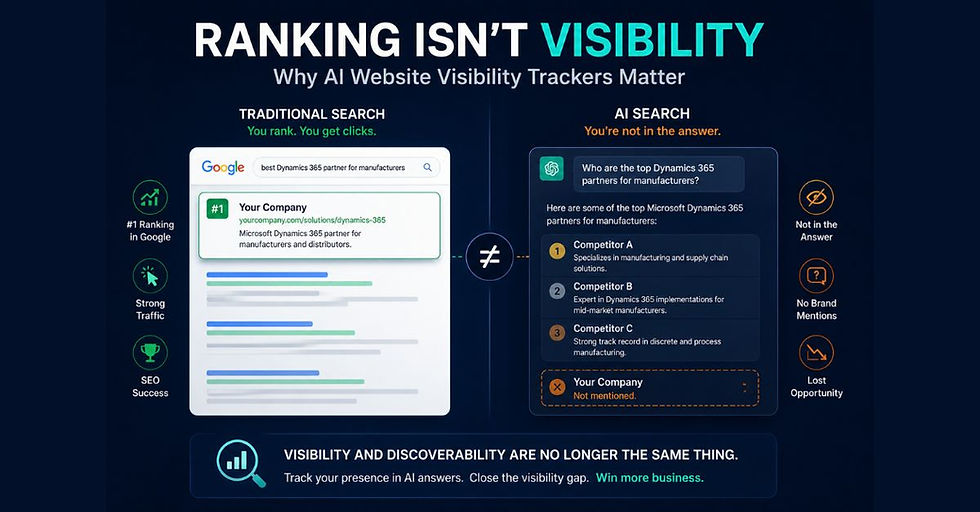
Today, buyers aren’t scanning search results.
They’re asking Copilot, ChatGPT, and Gemini for answers.
And those systems don’t list options.
They decide.
And if you’re not part of that decision, you’re not part of the market.
Here’s the shift:
Visibility is no longer about being found. It’s about being interpreted.
If you want the full breakdown of how this shift is playing out, see AI Search vs. Traditional Search for Microsoft Dynamics Partners.
And that creates a new problem most partners aren’t thinking about yet:
Who controls how AI uses your content?
That’s where LLMS.TXT shows up.
Not as a tool, but as a signal.
You’ll hear it described as the “robots.txt for AI.
”A simple file that tells AI crawlers what they can and can’t do with your content.
That’s the idea.
The reality is simple.
No standard.
No guarantees AI systems are even using it.
And there is a lot of noise about what it might become.
So, the real question isn’t “What is LLMS.TXT?”
It’s this:
Does it matter yet, or is ignoring it the bigger risk?
Let’s break it down.
Table of Contents
What LLMS.TXT Actually Is (and Why It Exists)

At its core, LLMS.TXT is a control layer.
It’s a simple text file that sits on your website and signals to AI crawlers what they can and can’t use.
The “LLMS” stands for Large Language Model Systems.
Think of it as the AI-era extension of robots.txt.
If robots.txt manages how search engines crawl your site, LLMS.TXT is designed to influence how AI systems interpret and use your content.
It applies to crawlers like GPTBot (OpenAI), ClaudeBot (Anthropic), and PerplexityBot.
The idea is straightforward:
define what’s open, what’s restricted, and what stays off-limits.
Here’s a simple example:
User-Agent: GPTBot
Disallow: /private/
Allow: /blog/
This is what control looks like at the page level.
You’re telling AI systems: this content is usable, this content isn’t.
That might sound small. It’s not.
For Microsoft Partners and ISVs, your website isn’t just content.
It’s your IP. Your positioning. Your expertise in the ecosystem.
And in a world where AI systems are summarizing, recommending, and reshaping that content, the question becomes:
Do you have any say in how it’s used, or are you handing that over by default?
LLMS.TXT is one of the first attempts to answer that.
Why Everyone Is Suddenly Talking About LLMS.TXT
LLMS.TXT didn’t trend by accident.
It spiked when the platforms closest to SEO and websites made the move.
Semrush started supporting LLMS.TXT in its tools.
Wix rolled out built-in LLMS.TXT management inside its platform.

When those two lean in, it’s not noise. It’s a signal.
Here’s what that signal means:AI content governance is moving from theory to infrastructure.
SEO platforms are preparing for a world where AI crawlers have their own rules.
Website platforms are positioning themselves as AI-ready by default.
For Microsoft Dynamics 365 Partners and ISVs, this isn’t about a file.
It’s about where control is moving.
If the tools you already rely on are building around LLMS.TXT, they’re not reacting to demand.
They’re preparing for a standard.
And standards don’t show up all at once.
They start like this.
Quiet adoption.
Early tooling.
No official confirmation.
Then suddenly, they’re expected.
To be clear, no major AI platform has confirmed support.
But that’s not the point.
The point is this:
The ecosystem around AI is starting to standardize.
And when that happens, the standard usually follows.
We’ve seen this before.
Robots.txt wasn’t enforced when it started.
Neither was sitemap.xml.
They became standard because the industry decided they were.
LLMS.TXT is at that stage now. Before it becomes expected.
Google Just Complicated the LLMS.TXT Conversation
Then Google complicated the picture.
Recently, Google’s Chrome Lighthouse team added an experimental llms.txt audit inside its new “Agentic Browsing” category.
That changes the conversation.
While Google Search has publicly said LLMS.TXT is not required for AI Overviews or AI search visibility, Chrome’s developer tools are now actively checking for it.
Here’s the distinction:
Google Search is talking about rankings and visibility.
Chrome Lighthouse is talking about agent readiness.
That’s a very different conversation.
Lighthouse frames LLMS.TXT as a way to help AI agents understand site structure and primary content more efficiently. Without it, agents may spend more time crawling and interpreting your site.
That doesn’t mean LLMS.TXT is suddenly a ranking factor.
It isn’t.
But it does signal something important:
The AI ecosystem is beginning to build around a machine-readable structure.
That’s exactly how standards start.
Not with official announcements.
With tooling.
Does LLMS.TXT Actually Work Right Now?
Short answer: no. Not in any confirmed way.
No major AI company has said they’re reading or enforcing LLMS.TXT.
Most AI crawlers still rely on robots.txt and whatever content they can access.
Right now, LLMS.TXT is closer to a proposal than a standard.
So why does it matter?
Because this is how standards start.
First, a few platforms support it.
Then, early adopters implement it.
Then one day, it becomes expected.
We’ve seen this before.
Robots.txt wasn’t enforced when it launched.
It was a suggestion.
Then it became the default.
LLMS.TXT is in that phase now.
And here’s the part most partners miss:
When AI systems start respecting it, they won’t wait for you to catch up.
The sites that already have structure, rules, and signals in place will shape how their content is used.
Everyone else will be reacting.
That’s the difference.
Not whether it works today.
Whether you’re ready when it does.
Why This Matters for Microsoft Partners and ISVs
If you’re a Microsoft Partner or ISV, your visibility isn’t optional. It’s oxygen.
But the way visibility works has changed.
Buyers aren’t comparing lists anymore.
They’re asking Copilot, ChatGPT, and Gemini for answers.
This is being driven by a shift toward conversational queries rather than keywords. We break that down in The Rise of Conversational Queries.
And those systems don’t present options. They make selections.
Here’s the shift:
Instead of searching for “Dynamics 365 manufacturing add-ons,” a buyer asks a direct question.
And the system responds with one answer.
The one it trusts.
That’s the new bottleneck.
Not traffic.
Not rankings.
Trust and interpretation.
That’s why this matters.
Your website isn’t just content.
It’s the input AI systems use to understand who you are, what you do, and where you fit.
If that input is unclear, incomplete, or misinterpreted, you don’t just rank lower.
You get left out of the answer.
Example:
A CIO asks Copilot:
“Who are the top ISVs for field service add-ons for Business Central?”
Is your content structured, accessible, and aligned?
You’re part of the answer.
If it’s not?
You’re invisible, even if you dominate Google.
That’s the difference.
And this is where LLMS.TXT connects.
It’s not the whole strategy.
But it is one of the first signals that you’re thinking about how AI systems access and use your content.
Put differently:
It’s a small step toward controlling how your expertise is interpreted.
For partners and ISVs, implementing it says three things:
You understand where discovery is going
You care how your content is used and attributed
You’re preparing before the rules are fully defined
This isn’t optimization. It’s positioning.
And in an AI-driven market, positioning is what determines whether you’re included or ignored.
Website Reality Check: WordPress, Wix, and Beyond
This is where it stops being theoretical.
Most Microsoft Partners and ISVs are running on WordPress or Wix.
And those platforms handle LLMS.TXT very differently.
That matters more than it seems.
Because everything we’ve talked about, control, access, interpretation, comes down to whether your platform lets you act on it.
So, the real question isn’t just “What is LLMS.TXT?”
It’s: Can you implement it, and how much control do you actually have?
The answer depends on your platform.

If You’re on WordPress | WordPress llms.txt
WordPress gives you control if you know where to look.
There’s no native LLMS.TXT support yet.But that doesn’t stop you from implementing it.
At a basic level, it looks like this:
User-Agent: GPTBot
User-Agent: ClaudeBot
Disallow: /wp-admin/
Allow: /blog/
This is where theory turns into action.
You’re defining what parts of your site AI systems can access, and what stays off-limits.
In WordPress, that control sits at the file level.
Create the file manually, then upload it to your root directory via FTP or your hosting file manager.
If you’re using tools like Yoast SEO, Rank Math, or All in One SEO, you can often manage it alongside robots.txt and sitemap.xml.
Same interface. Different purpose.
The key point: WordPress doesn’t block you from doing this. It just doesn’t guide you.
Which means the responsibility sits with you.
If You’re on Wix | Wix llms.txt
Wix takes the opposite approach.
It handles LLMS.TXT for you.
No manual setup.
No file management.
And, at least for now, no option to customize or edit it.
The platform generates LLMS.TXT directives in the background, signaling to AI crawlers how your site should be treated.
That means your site is already participating in this next phase of AI visibility, whether you’ve thought about it or not.
But there’s a tradeoff.
You get convenience. You give up control.
You don’t decide what’s included or excluded.
The platform does.
That’s the difference.
The Bigger Picture
This isn’t about WordPress vs Wix.
It’s about control.
LLMS.TXT is a small file.
But it points to a bigger shift:
From optimizing for search engines to shaping how AI systems interpret your brand.
Because when Copilot, ChatGPT, or Gemini explain who you are, they’re not just pulling content.
They’re forming a narrative.
And that narrative depends on how extractable your content is. Here’s what actually gets surfaced in AI answers: What Content Ranks in AI Overviews.
And you don’t get ten chances to influence it.
You get one.
That’s what changes.
Your website is no longer just something buyers read.
It’s something AI systems translate.
If that translation is off, incomplete, or inconsistent, you don’t just lose visibility.
You lose how you’re understood.
So the question isn’t whether LLMS.TXT matters on its own.
It’s whether you’re thinking about how your content is accessed, interpreted, and represented in AI-driven discovery.
LLMS.TXT is one of the first signals that you are.
How LLMS.TXT Fits into Your Broader AI + SEO Strategy
LLMS.TXT isn’t a strategy.
It’s a signal.
A small, technical step that points to a much bigger shift in how visibility works.
Because AI visibility isn’t just about being crawled.
Authority still plays a role in what AI systems trust and surface. If you’re thinking about backlinks and credibility, see AI Search and Domain Authority.
It’s about how your content is used, interpreted, and represented.
That’s the difference.
Here’s where LLMS.TXT fits:
Content strategy
It forces you to think about what’s open to AI systems and what isn’t.
Control and protection
It gives you a way to define boundaries before your expertise is reused, reshaped, or detached from your brand.
Readiness
It signals that you’re preparing for a discovery model where answers matter more than clicks.
And while the file itself is still early, the shift behind it isn’t.
The companies that win in AI-driven discovery won’t just publish content.
They’ll shape how that content is interpreted.
LLMS.TXT is one of the first steps in that direction.
A Quick Way to Implement It

If you want to act on this today, it takes five minutes.
Create a file called llms.txt and add something like this:
User-Agent: GPTBot
User-Agent: ClaudeBot
User-Agent: PerplexityBot
Disallow: /confidential/
Allow: /resources/
This is the starting point.
You’re defining what AI systems can access, and what stays off-limits.
From there:
Upload it to your root directory (yourdomain.com/llms.txt)
Confirm it loads in your browser
Watch your logs for activity from AI crawlers
That’s it.
It’s not complex. It’s a signal.
Right now, the advantage isn’t a perfect setup.
It’s in deciding what matters before it becomes expected.
Looking Ahead: From Hype to Habit

LLMS.TXT is still early.
Not a standard. Not enforced. Not fully understood.
But that’s how these shifts start.
The difference this time is what’s at stake.
Search is used to decide what gets seen.
Now AI decides what gets said.
That’s the shift.
And for Microsoft Dynamics 365 Partners and ISVs, the rules change.
It’s no longer enough to be indexed.
You need to be interpreted correctly.
Because when Copilot or ChatGPT explains your solution, that explanation becomes your positioning.
Not your website.
Not your messaging.
The answer.
And that answer directly shapes:
Who makes your shortlist
How are you compared
Whether you’re trusted
That’s why LLMS.TXT matters.
Not because it’s powerful on its own.
Because it signals that you’re preparing for a system where visibility is controlled by interpretation, not ranking.
Today it’s optional.
Soon it won’t be.
What Everyone’s Asking About LLMS.TXT Right Now
Is any AI reading or respecting LLMS.TXT today?
No confirmed evidence.
No major AI platform has said they’re using it or enforcing it.
Right now, LLMS.TXT sits in that early stage, visible, discussed, but not required.
That doesn’t make it irrelevant.
It means you’re early.
How is LLMS.TXT different from robots.txt or sitemap.xml?
Robots.txt controls crawl access.
Sitemap.xml supports indexing.
LLMS.TXT is trying to do something else.
It’s not just about access.
It’s about influence, signaling how AI systems should use, interpret, and represent your content.
That’s the shift.
Do I need a tool to create an LLMS.TXT file?
No.
A simple text file with basic directives is enough.
Most tools just speed up what you can already do manually.
The real decision isn’t how to generate the file.
It’s what you want AI systems to access in the first place.
Final Thoughts
LLMS.TXT isn’t a standard.
It’s not enforced.
It’s not fully adopted.
And it doesn’t “work” in any guaranteed way yet.
But it points in a clear direction.
A world where publishing content isn’t enough.
You need to shape how AI systems interpret and represent it.
That’s the shift.
And the advantage won’t go to the companies waiting for confirmation.
It’ll go to the ones who act while it’s still early.
Because once this becomes standard, it’s no longer a differentiator.
It’s table stakes.
So the question isn’t whether LLMS.TXT is perfect.
It’s whether you’re paying attention to what comes next.
Start simple.
Put the file in place.
Be intentional about what you make available.
Think about how your content is being interpreted.
That’s where this is going.
And the partners who move now won’t be asking “What happened?” later.
They’ll already be part of the answer.
What to Do Next
If you’re reading this and thinking, we should probably get ahead of this, you’re right.
This doesn’t require a full rebuild.
It starts with a few clear moves:
Put an LLMS.TXT file in place
Decide what content you want AI systems to access
Make sure your content is structured so AI can interpret it correctly
If you’re not sure what that looks like in practice, start with What Content Ranks in AI Overviews.
That’s the foundation.
From there, the real work is making sure your brand shows up correctly
when AI systems generate answers.
That’s where most teams get stuck.
If you want to move faster and do this right, we can help.
At Marketeery, we work with Microsoft Dynamics 365 Partners and ISVs to:
Make your content easier for AI systems to interpret and select
Ensure your expertise is represented accurately in AI-generated answers
Build a strategy that keeps you visible as discovery shifts
Because the goal isn’t just to publish content.
It’s to make sure your brand is the one AI systems choose to represent.
About Jon Rivers

Jon Rivers is the Co-Founder and COO of Marketeery. His technical background and sales and marketing skills enable him to understand solutions quickly and help drive more effective marketing campaigns. He's an international top-rated speaker. You can find Jon on LinkedIn.