AI Search Metrics: The 5 KPIs That Matter Now

Introduction: The Metrics Haven't Failed. The Search Experience Has
Most marketing teams are tracking the wrong search metrics.
Not because rankings stopped mattering.
Because rankings stopped telling the whole story.
For years, the formula was simple.
Rankings increased.
Traffic followed.
Opportunities followed.
The relationship was predictable.
Today, it's getting more complicated.
Buyers aren't always starting with Google anymore.
They're asking ChatGPT.
They're using Microsoft Copilot.
They're reading Google AI Overviews.
They're turning to Gemini and Perplexity for recommendations before they ever visit a website.
And that's changing what visibility looks like.
Picture this.
A buyer asks:
"Who are the best Microsoft Dynamics partners for manufacturers?"
Within seconds, the AI generates an answer.
Maybe it recommends two companies.
Maybe three.
But not ten.
Now here's the problem.
Your company ranks well for manufacturing-related keywords.
Your content is generating traffic.
Your SEO dashboard looks healthy.
But your company never appears in the answer.
That's the shift.
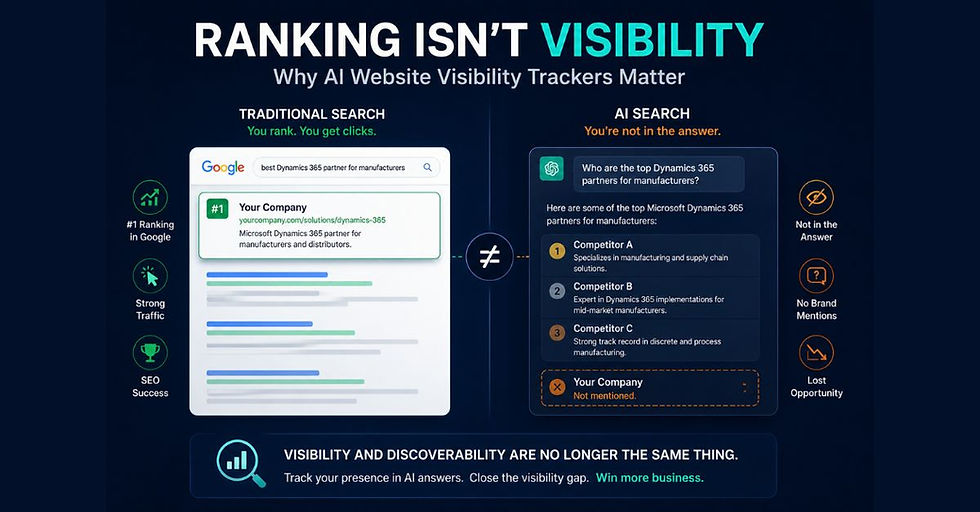
A company can rank first in Google and still be absent from the recommendation a buyer actually sees.
The rankings didn't break.
The measurement framework did.
Most SEO reporting was built for a world where search engines returned links.
AI search returns answers.
Traditional metrics tell you where you rank.
They don't tell you whether AI is citing your content, mentioning your brand, or recommending your expertise.
And that's creating a new visibility gap.
Because visibility and discoverability are becoming two different things. We explored this shift in more detail in our guide to AI Search vs. Traditional Search.
A company can have strong rankings and weak AI visibility.
A company can have modest rankings and appear consistently in AI-generated answers.
Put differently:
Ranking and recommendation are no longer the same thing.

That's why marketing teams need a broader measurement framework.
Not because traditional SEO metrics are obsolete.
They're not.
Organic traffic still matters.
Rankings still matter.
Conversions still matter.
But none of those metrics tell the full story anymore.
The question is no longer:
"Where do we rank?"
It's:
"Are we being recommended?"
To answer that question, marketers need a new set of KPIs.
Here are the five AI search metrics that matter now.
Table of Contents
1. AI Citation Rate
Most marketers know where they rank.
Far fewer know whether AI is citing them.
That's becoming a problem.
Because rankings and citations measure two different things.
Rankings tell you whether a search engine found your content.
Citations tell you whether AI trusts it enough to use it.
And those aren't always the same thing.
A company can rank first and never appear in an AI-generated answer.
A competitor ranking fourth might be cited consistently.
That's because AI systems aren't simply looking for the highest-ranking page. They're looking for the best source.
The clearest answer.
The strongest explanation.
The content that's easiest to extract and reference.
That's why the AI citation rate is one of the most important AI search metrics you can track.
It measures how often your content is referenced across platforms like ChatGPT, Microsoft Copilot, Google AI Overviews, Gemini, and Perplexity.
Put differently:
If traditional SEO is about ranking, AI search is increasingly about being cited.

Here's an example.
Imagine two Microsoft Dynamics partners targeting manufacturers.
One has invested heavily in traditional SEO and ranks well across several industry terms.
The other has built detailed content that answers specific buyer questions about inventory management, production planning, job costing, and operational efficiency.
Which company is AI more likely to reference when someone asks:
"How can manufacturers improve profitability with Dynamics 365 Business Central?"
Not necessarily the company with the highest ranking.
The company with the most useful answer.
That's the shift.
Traditional search rewarded pages that could win the click.
AI search rewards content that can support the answer.
That's also why understanding what content ranks in AI Overviews has become increasingly important for marketing teams focused on AI visibility.
Why Citation Rate Matters
Citation rate is often one of the earliest indicators of AI visibility.
Before traffic increases.
Before leads increase.
Before revenue is impacted.
AI systems start sending signals.
They begin referencing your content more frequently.
They surface your expertise more often.
They include your brand in conversations that matter.
That's valuable because buyers increasingly encounter brands through AI recommendations before they ever visit a website.
If your content is being cited consistently, you're gaining visibility at the point where decisions are starting to take shape.
How to Measure It
Measuring citation rate doesn't need to be complicated.
Start by tracking:
How often does your content appear in AI-generated answers?
Which pages are cited most frequently?
Which competitors are cited alongside you?
Changes in citation frequency over time
The goal isn't simply to count mentions.
The goal is to determine whether AI systems consider your content a credible source.
Because when AI consistently cites your content, it's telling you something important.
You're becoming part of the answer.
2. AI Referral Traffic Quality
Most traffic metrics tell you how many people arrived.
They don't tell you how ready they were to act.
That's becoming a bigger problem in AI search.
Because not all visitors arrive the same way.
Someone clicking a traditional search result is often still gathering information.
They're exploring options.
Comparing vendors.
Researching solutions.
Someone arriving from ChatGPT, Copilot, Gemini, Perplexity, or Google AI Overviews is often further along.
They've already asked the question.
They've already reviewed the answer.
They've already seen recommendations.
In many cases, they've already narrowed their list.
That's the shift.
Traditional search generates visits.
AI search increasingly generates evaluations.
By the time a buyer clicks through from an AI-generated response, they're often looking for validation, proof, or the next step.
Not basic information.
That's why AI referral traffic deserves its own measurement framework.
Why Traffic Volume Isn't Enough
One of the easiest mistakes to make is evaluating AI traffic the same way you evaluate organic search traffic.
More visitors don’t automatically mean better results.
Imagine two traffic sources.
The first sends 1,000 visitors researching a problem.
The second sends 200 visitors evaluating solutions.
Which audience would you rather have?
That's the question marketers should be asking.
Because traffic quality often matters more than traffic volume.
Especially in B2B environments where a single qualified opportunity can be worth significantly more than hundreds of casual website visits.
Put differently:
AI traffic isn't primarily a discovery metric.
It's an intent metric.
What to Measure
As AI referrals become more common, create a separate reporting segment for AI-driven traffic and track:
Engagement rate
Time on site
Conversion rate
Lead quality
Pipeline influence
Those metrics reveal whether AI visibility is translating into meaningful business outcomes.
Because visibility alone isn't the goal.
Business impact is.
The Bigger Signal
Today, AI referral traffic still accounts for a relatively small share of overall website traffic for many organizations.
That's expected.
The channel is still evolving.
But focusing only on volume misses the point.
The more important question is whether AI recommendations are driving qualified visitors who engage, convert, and move through the buying process.
Because that's ultimately what this KPI measures.
A citation tells you AI recognizes your expertise.
A qualified visit tells you buyers do too.
3. Brand Mention Share
AI isn't just surfacing information.
It's shaping consideration.
That's why brand mention share matters.
For years, authority was largely measured through backlinks.
The more credible websites linking to your content, the stronger your authority signals become.
That still matters.
But AI search introduces a new dynamic.
Because buyers aren't always reviewing ten search results and building their own shortlist.
Increasingly, they're asking AI to help build it for them.
When someone asks:
"Who are the best Microsoft Dynamics partners for manufacturers?"
or
"What are the top inventory management solutions for Business Central?"
AI doesn't simply return a page of links.
It generates a recommendation.
And certain brands appear repeatedly.
That's where brand mention share comes in.
It measures how often your company is mentioned when buyers ask questions related to your expertise.
Why It Matters
Buyers don't evaluate every option.
They create a shortlist.
Increasingly, AI is helping build that shortlist.
That's the shift.
A prospect may encounter your brand in ChatGPT, Copilot, Gemini, Perplexity, or Google AI Overviews long before they ever visit your website.
In some cases, that first mention becomes their first impression.
And first impressions matter.
Because familiarity influences trust.
And trust influences decisions.
Put differently:
Visibility gets you seen.
Mention share gets you considered.

That's why two companies with similar rankings can experience very different outcomes in AI search.
One consistently appears in AI-generated recommendations.
The other doesn't.
Only one becomes part of the buying conversation.
What to Measure
Start by tracking:
How often your brand appears across AI platforms
Which topics generate the most mentions
Which competitors are mentioned alongside you
Changes in mention frequency over time
The goal isn't simply to count mentions.
The goal is to understand whether AI associates your brand with the topics you want to own.
Because if competitors dominate conversations around your expertise, you're losing visibility where buying decisions increasingly begin.
The Bigger Signal
One of the most interesting aspects of brand mention share is what it reveals.
AI doesn't form opinions from a single signal.
It learns from the totality of your digital presence.
Your content.
Your thought leadership.
Your industry expertise.
Your customer success stories.
Your reputation across the web.
All of it contributes to whether AI sees your brand as relevant, credible, and worth mentioning.
That's why this KPI matters.
You're not simply measuring awareness.
You're measuring whether your brand is becoming part of the conversation.
Because in AI search, consideration often starts before the click.
4. Topical Authority Coverage
Most companies don't have a content problem.
They have a coverage problem.
That's an important distinction.
Many organizations are publishing content consistently.
They're creating blog posts.
Optimizing pages.
Targeting keywords.
And still struggling to gain traction in AI search.
Why?
Because AI isn't evaluating content the same way traditional search engines do.
A single article can answer a question.
But it can't establish expertise.
That's the shift.
AI doesn't reward the page that knows the answer.
It rewards the brand that understands the topic.
For years, SEO strategies were often built around individual keywords.
Find a term.
Create a page.
Rank for the query.
Repeat.
That approach can still generate traffic.
But AI systems are increasingly looking beyond individual pages.
They're evaluating whether an organization demonstrates expertise across an entire subject area.
That's where topical authority coverage comes in.
Topical authority coverage measures how completely your content addresses a topic, not just a keyword.

Why It Matters
Imagine two Dynamics partners targeting manufacturers.
Both rank for Business Central implementation.
Only one owns the conversation.
In addition to implementation content, they've published resources covering:
Inventory management
Production planning
Warehouse operations
Reporting and analytics
Copilot use cases
Industry-specific challenges
The other has a handful of service pages.
Which company is more likely to be viewed as an authority?
The answer is obvious.
And increasingly, AI sees it the same way.
Traditional SEO often rewarded relevance.
AI search increasingly rewards completeness.
This is also one reason domain authority and backlinks still matter in AI search, even as visibility shifts from rankings to recommendations.
Put differently:
AI isn't looking for isolated answers.
It's looking for trusted sources.
What to Measure
Start by identifying the topics your organization wants to own.
Then evaluate how much of those conversations your content actually covers.
Ask questions like:
What buyer questions are we answering?
What questions are we missing?
Where are the biggest content gaps?
Which topics do competitors cover that we don't?
The goal isn't to publish more content.
The goal is to build more complete coverage.
Because volume and authority are not the same thing.
The Bigger Signal
One of the most common reasons companies struggle to appear in AI-generated answers is surprisingly simple.
They have content.
But they don't have depth.
They answer some questions.
But not enough of them.
They publish individual assets.
But never build a connected body of expertise.
AI systems notice that.
Because authority isn't established through a single page.
It's established through consistent evidence across an entire topic.
That's why topical authority coverage matters.
It tells you whether you're simply creating content.
Or building expertise.
And in AI search, those are becoming two very different things.
5. AI Crawl Activity
AI visibility isn't just about what you publish.
It's about what AI can actually consume.
That's why crawl activity matters.
Most organizations focus on the outcomes.
Citations.
Mentions.
Referral traffic.
Those metrics are important.
But they're all downstream signals.
Before AI can cite your content, it has to be discovered.
Before it can recommend your expertise, it has to understand it.
Major AI platforms use their own crawlers to discover and refresh information across the web, including OpenAI's web crawlers.
That's the shift.
Traditional SEO focused on whether Google could find your website.
AI search requires a broader question:
Are AI systems actively discovering and processing your content?
Because visibility starts long before a citation appears in an AI-generated answer.
Why It Matters
Imagine you've published a comprehensive guide on a topic your buyers care about.
It's well-written.
Well-structured.
Packed with expertise.
But AI platforms rarely revisit it.
The content may still perform in traditional search.
But its ability to influence AI-generated responses becomes limited.
The opposite can be equally revealing.
Sometimes AI systems crawl a page regularly but rarely cite it.
That's useful information.
Because it helps identify where the problem actually exists.
If AI isn't accessing the content, you may have a technical issue.
If AI is accessing the content but not using it, you likely have a content quality, authority, or coverage issue.
That's an important distinction.
What to Measure
Start by tracking:
Visits from AI crawlers
Crawl frequency on key content pages
Changes in crawl activity over time
Which content AI systems revisit most often
The objective isn't to maximize crawler visits.
The objective is to understand whether AI platforms are actively consuming the information you want associated with your brand.
The Bigger Signal
Crawl activity won't tell you everything.
But it often tells you something early.
Long before you see a citation.
Long before you see a mention.
Long before you see referral traffic.
Put differently:
Discovery comes before recommendation.
Understanding comes before citation.
That's why crawl activity belongs on the dashboard.
Not because it's the most important AI search KPI.
Because it's often the first indication that AI systems are paying attention.
And if they're not paying attention, none of the other metrics matter.
The Future of Search Reporting Looks Different
The problem isn't that rankings stopped mattering.
The problem is that rankings stopped telling the whole story.
For years, search visibility was relatively straightforward to measure.
Rankings improved.
Traffic increased.
Results followed.
Today, buyers are discovering information differently.
They're asking AI systems for recommendations.
They're receiving answers instead of lists.
And they're often forming opinions before they ever visit a website.
That changes what visibility means.
A company can rank well and still be absent from the conversation.
A competitor can generate fewer clicks and still become the brand AI recommends most often.
That's why marketing teams need to rethink how they measure search performance.
Not because traditional SEO metrics are obsolete.
They're not.
Traffic still matters.
Rankings still matter.
Conversions still matter.
But those metrics were designed to measure a search experience that is rapidly evolving.
AI search introduces new questions.
Is AI citing your content?
Is it mentioning your brand?
Does it view your organization as an authority on the topics that matter most?
Are buyers discovering you through AI-generated recommendations?
For organizations looking to answer those questions, measuring AI visibility is often the first step. Understanding where your brand appears, where competitors are being recommended, and where visibility gaps exist can reveal opportunities traditional SEO reporting may miss.
Those answers increasingly influence visibility, consideration, and ultimately revenue.
Put differently:
The goal is no longer just to rank.
The goal is to become part of the answer.
The organizations that understand that shift early will have a significant advantage.
Because AI search isn't replacing traditional search.
It's reshaping how buyers discover expertise.
And the companies measuring the right signals will be in the best position to earn that visibility.
Want to Know How Visible Your Business Is in AI Search?
Most organizations can tell you where they rank on Google.
Few can tell you whether AI is recommending them.
That's exactly why organizations are starting to measure how they're getting found across AI search platforms and why it’s becoming a competitive advantage.
As AI search continues to influence how buyers discover information, organizations need visibility beyond rankings and traffic. They need to understand how AI platforms perceive their content, their expertise, and their brand.
At Marketeery, we help organizations measure and improve their visibility across AI search platforms, including ChatGPT, Microsoft Copilot, Google AI Overviews, Gemini, and Perplexity.
Whether you're trying to understand your current AI visibility, identify content gaps, or improve your presence in AI-generated recommendations, the first step is understanding where you stand today.
Schedule an AI Visibility Assessment to see how your organization appears across the AI platforms your buyers are already using.
Frequently Asked Questions About AI Search Metrics
What is the most important AI search KPI?
If you're just getting started, focus on AI citation rate.
It's the clearest indicator that AI platforms view your content as a trustworthy source.
Before AI can drive traffic, generate mentions, or influence buying decisions, it has to reference your content in the first place.
That's why citation rate is often the best leading indicator of AI visibility.
Do traditional SEO metrics still matter?
Absolutely.
Rankings, organic traffic, and conversions remain important.
The challenge is that they no longer tell the whole story.
A company can rank well and still be absent from AI-generated answers.
That's why AI search metrics should complement traditional SEO reporting, not replace it.
How often should AI search metrics be reviewed?
Most organizations should review AI search metrics monthly alongside traditional SEO performance.
However, citation rates, brand mentions, and AI visibility trends are often more valuable when evaluated over longer periods.
The goal is to identify patterns, not react to daily fluctuations.
What's the difference between AI citation rate and brand mention share?
Citation rate measures how often AI uses your content as a source.
Brand mentions share measures how often AI mentions your company when discussing topics related to your expertise.
A platform may mention your brand without directly citing your content.
Ideally, you want both.
Why is topical authority important for AI search?
AI systems prefer sources that demonstrate expertise across an entire topic rather than a single keyword.
Organizations that answer a broad range of related questions are cited more often than those focused on isolated pieces of content.
Put differently:
AI rewards expertise that can be demonstrated, not just claimed.
Which AI platforms should marketers monitor?
At a minimum, organizations should monitor visibility across:
ChatGPT
Microsoft Copilot
Google AI Overviews
Gemini
Perplexity
Each platform retrieves and presents information differently, which means visibility can vary significantly from one platform to another.
Are AI search metrics replacing SEO?
No.
They're expanding it.
SEO is still about helping buyers discover your content.
AI search metrics help you understand whether AI systems are recommending content once it's discovered.
The future isn't SEO or AI search.
It's both.
About Jon Rivers

Jon Rivers is the Co-Founder and COO of Marketeery. His technical background and sales and marketing skills enable him to understand solutions quickly and help drive more effective marketing campaigns. He's an international top-rated speaker. You can find Jon on LinkedIn.