AI Search vs Traditional Search: A Guide for Microsoft Dynamics Partners

Updated: Apr 15

Buyers aren’t searching the way they used to.
And if you’re a Microsoft Dynamics Partner or ISV, that shift hits even harder.
Today’s prospects don’t start with keywords; they begin with questions.
And the places they ask those questions aren’t always Google anymore.
They’re asking ChatGPT, Perplexity, Microsoft Copilot, and Gemini.
This shift highlights the growing difference between AI Search vs Traditional Search, especially for Microsoft Dynamics 365 partners and ISVs trying to stay visible in modern buyer discovery.
ChatGPT is no niche experiment anymore.
OpenAI shared with Axios that it now handles around 2.5 billion prompts every single day from users around the world, and roughly 330 million of those are coming from right here in the U.S.
That’s the wake-up call: If you’re not showing up in AI-driven answers, you’re already behind.
Picture this. You’re a Dynamics buyer looking for answers.
On Google, you type: “Dynamics 365 ISV manufacturing software.”
You get a long list of links:
Microsoft AppSource listings, vendor websites, and blog posts.
You scroll. You compare. You guess which one might fit.
And if you’re not on page one?
You’re not even part of the conversation.
Now layer on the shift to AI search.
Over 60% of B2B buyers are already starting their journey with tools like ChatGPT, Perplexity, Copilot, or Gemini, which makes the risk of invisibility even higher.
Now picture the same search in ChatGPT or Gemini.
This time, you ask a full question:
“What’s the best Dynamics 365 ISV solution for manufacturers to manage production and costs?”
Within seconds, you get a conversational answer that feels tailored to you.
Sometimes it even narrows things down to one or two vendors.
Here’s the catch:
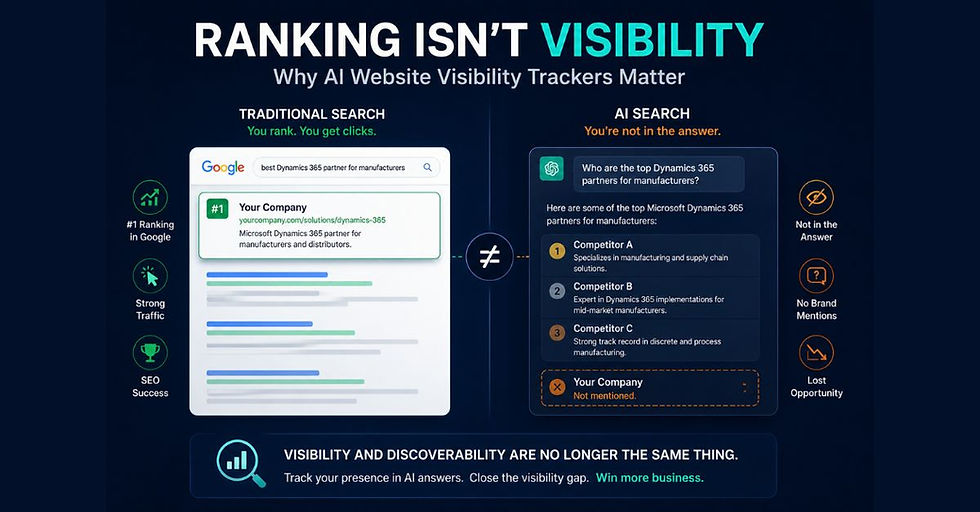
In AI search, there’s no second page of results.
You’re either in the answer or you’re invisible.
That’s the difference:
Traditional search makes the buyer do the heavy lifting.
AI search interprets for them, understanding context, intent, and meaning to deliver answers directly.
The good news?
With the right strategy, your business can still stay ahead of the competition.
For Microsoft Dynamics Partners and ISVs, that means you can’t rely on old SEO tactics alone.
If your content isn’t optimized for AI search, you risk disappearing from buyer discovery altogether.
The way prospects discover your content and decide if you’re worth shortlisting is fundamentally changing.
In this blog, we’ll break down:
What AI search really is
How it compares to traditional search
And what this new discovery model means for your Dynamics-focused business
Table of Contents
What Is AI Search?
AI search isn’t “the next Google.”

It’s a fundamental shift in how information gets found and how buyers discover Microsoft Dynamics partners and ISVs.
According to a 2025 nationwide survey by the Brookings Institution, 56% of American adults are already using AI tools, and 28% are using them every single week.
It’s a clear signal: AI isn’t a future trend.
It’s part of how people work, search, and make decisions today.

Instead of matching keywords across millions of pages, AI search uses large language models (LLMs) to:
interpret meaning
understand context
connect related topics
deliver answers in plain language
It’s not searching, it’s interpreting.
That’s why the Dynamics ecosystem is feeling this change more than most.
Your buyers aren’t typing “Dynamics 365 job costing module.”They’re asking:
“How do I manage project profitability in Dynamics 365 Business Central?”
And AI tools don’t return links.
They return answers.
Answers built from the content they trust most.
If that content isn’t yours?
You don’t get visibility.
You don’t get considered.
And you’re not part of the buying conversation.

From Keyword Matching to Semantic Understanding
Traditional search engines still operate on one simple rule: match the keywords.

If a buyer types: “Dynamics 365 job costing module.”
Google scans for those exact words across billions of pages.
But here’s the limitation:
Google doesn’t understand why they’re searching.
Is the buyer asking about budgeting?
Profitability?
Project management?
No clue, it just finds the phrase.
AI search flips that model completely.
Ask ChatGPT or Gemini:
“How can I manage project profitability in Dynamics 365 Business Central?”
Now the system interprets intent.
It understands what you’re talking about:
job costing
resource utilization
margins
project accounting
profitability analysis
Not just the words, the meaning behind the words.
And the answer feels like it came from a consultant who knows Dynamics inside and out… not from a list of links you must sort through.
This is the shift that matters for Dynamics Partners and ISVs.
Buyers aren’t searching for keywords anymore.
They’re expecting contextual explanations, not exact matches.
Which means your content has to help AI understand the topic, not just repeat the phrase.
Why LLMs Are Different from Algorithms Like Google’s
Google’s entire model was built on ranking factors:
backlinks
domain authority
click-through rates
keyword usage
page speed
That system rewarded consistency, but it still made the buyer do all the work.
They had to click, skim, compare, and decide what to trust.
AI search doesn’t work that way.
LLMs flip the model completely.
They don’t serve up a list of links.
They generate one contextual answer in real time.
And that answer is built from:
training data
the content they understand best
what they interpret as authoritative
natural language patterns
contextual cues inside your content
In other words, buyers don’t just get links anymore; they get insights.
And that matters even more in the Microsoft Dynamics ecosystem.
If someone asks: “What’s the best way to track project profitability in Dynamics 365 Business Central?”
Google gives them 10 blue links.LLMs give them one explanation and maybe one vendor recommendation.
So, your content isn’t just competing to “rank higher.”It’s competing to be selected by the AI as the most relevant, trustworthy, and helpful answer.
That’s the new battleground.
Traditional Search Engines: Strengths and Limitations
Before we dive deeper into AI search, it’s worth remembering why Google has dominated discovery for so long and where it still holds value for Microsoft Dynamics Partners and ISVs.
The Keyword-Centric Model
Traditional search has always been built on one idea: match keywords → return links.
If a buyer types: “Dynamics 365 project accounting add-on.”
Google scans billions of indexed pages looking for that phrase.
Then it ranks the results using factors like:
keyword usage
backlinks
domain authority
page speed
user engagement
For years, this worked because it was predictable.
If you followed SEO best practices, built backlinks, and optimized your pages, you could earn a spot on page one, and page one meant leads.
But here’s the limitation: Google stops at the list.
The buyer still must click, skim, compare, and decide which Partner or ISV to trust.
In contrast, AI search skips the list and jumps straight to the answer.
Ranking Factors That Still Matter
Even with the rise of AI search, traditional SEO isn’t going anywhere.
Backlinks from trusted sites — like ERP Software Blog, CRM Software Blog, MSDynamicsWorld, The Partner Index, and other industry outlets still tell Google your content is credible.
And your site still needs:
strong domain authority
high-quality content
technical SEO
fast load times
mobile optimization
These signals remain essential for ranking in Google and Bing.
But here’s the reality every Dynamics Partner needs to understand:
Traditional SEO helps you get found.
AI search decides whether you get chosen.
That’s the shift.
You’re no longer competing to climb the rankings.
You're competing to be the single answer AI pulls into the conversation.
AI Search vs. Traditional Search: How LLM Search Works
If traditional search is about matching keywords, LLM search is about understanding meaning.
Instead of forcing buyers to think like a search engine, AI-powered models finally think like buyers.
Here’s what makes the shift so big for Microsoft Dynamics Partners and ISVs:
Natural Language Queries
Buyers no longer type robotic phrases like:“Dynamics 365 manufacturing module pricing.”
They ask real questions: “How can Dynamics 365 help me manage production costs more effectively?”
Traditional search only ranks pages that match the words.
AI search understands the intent behind the words.
Why it matters: Your content must answer buyer questions directly, not just repeat the keyword.
Contextual Understanding and Relevance
LLMs don’t just scan for phrases.
They connect the dots.
Ask about “project profitability in Dynamics 365 Business Central,” and the AI instantly links related concepts like:
job costing
resource utilization
margin analysis
project accounting workflows
It understands the context, not just the query.
Why it matters:If your content doesn’t clearly explain these concepts, AI can’t map your expertise to the question, and you won’t appear in the answer.
Conversational Results Instead of Links
This is the game-changer.
Google gives the buyer a list of links.
AI tools like ChatGPT, Gemini, and Copilot provide the buyer with an answer, often in a structured, step-by-step format.
Sometimes the AI even highlights one or two vendors as recommended options.
There’s no second page.
No Scrolling.
No clicking around.
Why it matters: If you’re not the content the AI pulls from, you’re invisible even if your SEO is strong.
Understanding how LLMs interpret meaning is step one. The next step is knowing what types of content generative engines actually select and cite. We break that down in detail in our guide to what content ranks in AI Overviews and generative search tools.
Why This Shift Matters for Businesses
AI search isn’t just a new way to ask questions.
It's changing how buyers discover, compare, and choose Microsoft Dynamics Partners and ISVs.
And this shift brings both risk and opportunity.
Changing User Expectations
Buyers are no longer typing in keywords.
They’re asking full questions and expecting direct, context-aware answers.
Nearly 40% of U.S. adults have already used an AI tool to search for information, and 58% of Gen Z prefer asking AI tools over search engines.
Young people increasingly use social media & AI chatbots for information search (where do you search for information online?)
That next generation of business buyers?
They’re not scrolling through Google.
They’re asking Copilot, ChatGPT, Gemini, and Perplexity for answers and trusting what they get.
Why it matters: If your content doesn’t give AI the clarity it needs, you won’t appear in the answer. The buyer never finds you. And you’re not even part of the shortlist.
Opportunities for Content Discovery
But here’s the flip side, and it’s a big one.
AI search levels the playing field.
Smaller Partners and ISVs can compete with larger ones if their content:
answers real buyer questions
explains Dynamics concepts clearly
provides contextual detail AI can interpret
positions them as a trusted source
Imagine your content being the one answer Copilot surfaces when a prospect asks:
“What’s the best Dynamics 365 ISV solution for project costing?”
That’s visibility you could never buy with traditional SEO.
Why it matters: You don’t need the highest domain authority. You need the clearest, most helpful, most AI-friendly content.
Preparing for the Future of Search
AI search isn’t replacing Google overnight.
Buyers still use traditional search every day, and SEO still drives website traffic.
But the shift is happening.
Fast.
By 2026, Gartner predicts that 80% of B2B marketing strategies will include AI-powered search optimization.
Early movers are already seeing results, up to a 40% boost in lead visibility compared to competitors who haven’t adapted.
Why it matters: The partners who embrace AI search now will own the buyer conversation later. Everyone else will be trying to catch up.
Optimizing for Both Traditional SEO and AI Search
Here’s the reality: You can’t rely on old SEO tactics alone — but you also can’t ignore the foundation that still feeds Google and Bing.
Traditional SEO gets your content indexed.
AI search decides whether your content gets used.
Microsoft Dynamics Partners and ISVs need both to stay visible.
But the way you optimize is changing fast.
1. Keep Your Traditional SEO Strong — It Still Matters
Yes, SEO fundamentals remain essential:
Fast site speed
Mobile optimization
Clean technical SEO
Quality backlinks (ERP Software Blog, CRM Software Blog, MSDW, etc.)
Clear on-page structure
These help your content surface in Google, which still accounts for a large share of your traffic.
But SEO on its own won’t prepare you for AI-driven discovery.
2. Optimize Your Content So AI Can Interpret It
AI tools don’t rank pages based on keyword density. They interpret meaning and context.
Your content needs to make that easy:
Write in full, conversational Q&A formats
Use headings that clearly signal intent (“How Dynamics 365 Helps Manufacturers Reduce Production Costs”)
Break paragraphs into scannable sections
Explain concepts plainly, with examples
Avoid fluffy paragraphs that contain lots of words and no clarity
If your content doesn’t align with buyer intent, LLMs will skip it, even if your SEO is excellent.
3. Yes, We Need to Talk About LLMS.TXT (The Truth)
Here’s the honest update — and this is exactly what your LLMS.TXT article states:
The Truth About LLMS.TXT Hype, …
❌ No major AI company (OpenAI, Anthropic, Google) has confirmed they read or obey LLMS.txt.
✔ But SEO platforms like Semrush and website builders like Wix now support it.
And that’s the signal Partners shouldn’t ignore.
Just like robots.txt started as an optional best practice before becoming standard, LLMS.txt is following the same pattern:
first experimental,
then supported by SEO tools,
then quietly expected.
LLMS.txt does not yet influence AI crawling, but early adoption positions your brand for the moment it does.
For Dynamics Partners and ISVs, that means:
You show you're preparing for the next phase of AI discovery
You start governing how AI uses your content
You build the muscle now, before the industry shifts
If your site runs on Wix, LLMS.txt is automatically generated.
If you're on WordPress, you can add it manually or use tools like Semrush’s generator.
This isn’t about control today.
It's about readiness tomorrow.
4. Build “Answer Content,” Not Just “Ranking Content”
Traditional SEO focuses on getting on page one.
AI search focuses on returning one best answer.
That means your content must:
Lead with clarity
Directly answer buyer questions
Incorporate examples relevant to Business Central, Finance, SCM, CRM, ISVs
Use conversational phrasing AI can easily interpret
Stay focused on the intent behind the question, not just the keywords in it
AI search rewards content that teaches, not content that simply mentions keywords.
5. Align Every Page to Buyer Intent
LLMs understand intent, not just text.
That means pages optimized like this:
❌ “Dynamics 365 manufacturing ISV solution” (keyword-first)… won’t help you.
AI prefers pages like:
✔ “How manufacturers use Dynamics 365 to manage production costs and inventory.”
✔ “What to look for in a project accounting ISV for Business Central.”
When your content aligns with how buyers ask questions, AI models are far more likely to include it in their answers.
FAQ's
Is AI search going to replace Google and other traditional search engines?
Not overnight. Google and Bing continue to dominate traffic, and buyers rely on them daily.
But AI search is rapidly gaining traction, and Dynamics partners need to prepare for a hybrid world where both models matter.
How do I optimize my content for AI search?
Focus on conversational queries and plain-language answers.
Structure your blogs, FAQs, and solution pages to directly answer buyer questions, use clear headings, and add schema or metadata.
Consider how a buyer might ask a question aloud, and write your content to match.
What’s the biggest difference between AI search and traditional SEO?
Traditional SEO focuses on ranking links on page one.
AI search delivers direct answers in a conversational style.
That means you’re not just competing for clicks, you’re competing to be the chosen source surfaced by the AI.
Do backlinks and domain authority still matter in the age of AI search?
Yes.
Backlinks, authority, and technical SEO remain critical for traditional search and still help establish your content as credible.
But for AI search, the additional layer is how well your content answers contextual, intent-based questions.
Where should my business start if we’re new to AI search optimization?
Start with your highest-performing content, such as blogs, solution pages, or FAQs, that already drive traffic.
Refine sections into a Q&A style, add clarity, and test how your content appears in ChatGPT, Gemini, or Copilot.
From there, expand gradually across your site.
Will AI search highlight my AppSource listing?
Not directly.
AI surfaces the content it deems most relevant and authoritative.
That often means blogs, solution pages, or thought leadership content rather than raw listings.
If you want your AppSource solution to be visible, you need supporting content optimized for AI search.
Final Thoughts + Call to Action
Search isn’t what it used to be.
For years, winning visibility meant playing by Google’s rules: keywords, backlinks, domain authority, and page-one rankings. And while those fundamentals still matter, they’re no longer enough.
AI search has changed the game.
Instead of handing buyers a list of links, AI tools like Microsoft Copilot, ChatGPT, Gemini, and Perplexity deliver one direct, conversational answer.
And in that moment, you’re either in the answer… or nowhere at all.
For Dynamics Partners and ISVs, that shift is massive.
Your content can’t just rank; it has to be understood, interpreted, and trusted by AI systems.
That means creating clearer content, structuring it around natural-language questions, and preparing your website for the next wave of AI-driven discovery.
Even tools like LLMS.txt, which aren’t yet officially supported by AI crawlers, are early signals of where this is headed. Platforms like Semrush and Wix already support the format, and history tells us these “experimental” files often become tomorrow’s standards.
Visibility in the AI era isn’t about playing catch-up.
It's about getting ready now.
Here’s where to start:
Audit your content for clarity, purpose, and buyer intent
Rewrite key pages using real questions your prospects ask
Organize your content so AI can interpret context, not just keywords
Prepare your site for emerging AI signals, including LLMS.txt
Test how your content appears inside Copilot, ChatGPT, and Gemini
The partners who take these steps early will be the ones AI surfaces first, the ones buyers hear about, trust, and shortlist automatically.
Because AI search isn’t about ranking.
It's about being chosen.
Ready to get your content AI-ready?
If you want to understand where your content stands today and what to fix first, let’s talk.
Marketeery can guide you in modernizing SEO for AI-driven discovery, including content rewrites and emerging signals such as LLMS.txt.
Let’s make sure your brand shows up where tomorrow’s buyers are already searching.
About Jon Rivers

Jon Rivers is the Co-Founder and COO of Marketeery. His technical background and sales and marketing skills enable him to understand solutions quickly and help drive more effective marketing campaigns. He's an international top-rated speaker. You can find Jon on LinkedIn.