What Content Ranks in AI Overviews, ChatGPT, Copilot, and Other AI Search Tools?

Updated: Apr 17

Search has shifted from links to answers. Google AI Overviews, ChatGPT, Microsoft Copilot, Gemini, and other generative tools now synthesize information and present a single response to the buyer.
That shift is accelerating.
Gartner predicts traditional search engine traffic will decline by 25% by 2026 as generative AI and chatbots satisfy more user intent directly inside the interface.
That shift reflects a structural difference between traditional search and generative AI systems — a distinction we break down in detail in our guide on AI search vs traditional search for Microsoft Dynamics partners.
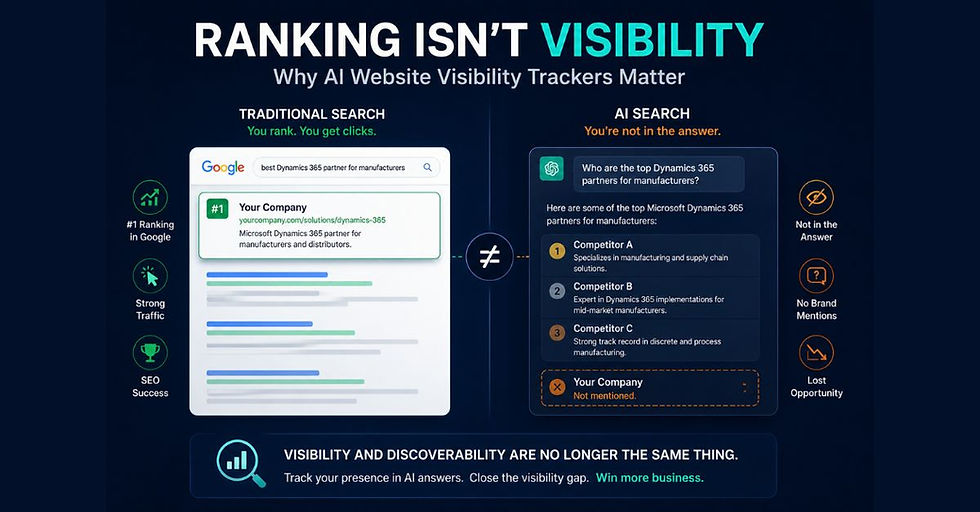
If your content is not selected, summarized, and cited inside that response, you are effectively invisible.
AI systems do not reward pages simply because they rank well.
They select sources that are structured clearly, aligned with real buyer questions, and reinforced by authority signals across the web.
What Actually Ranks in AI Search?
Content appears in AI Overviews and generative engines when it:
Answers specific buyer questions in natural language
Uses clear headings and structured sections
Includes definitions, comparisons, and FAQ blocks
Demonstrates proof, expertise, and consistency
Connects business problems to defined solutions
Explainer pages, comparison guides, implementation checklists, role-based use cases, and proof-driven resources consistently outperform generic blog posts written only for keyword coverage.
Most firms, including many Microsoft Dynamics partners, still publish as if traditional ranking were the primary objective.
AI search is optimizing for clarity, structure, and authority.
This guide explains how generative engines decide what to cite, which content formats are consistently selected, and how to build a structured content framework that strengthens visibility across AI platforms without weakening your existing SEO foundation.
Because in the AI era, ranking is not the finish line.
Being included in the answer is.
Table of Contents
How AI Search Engines Decide What to Cite
AI search engines do not rank pages the way traditional search does. They assemble responses.
According to Google’s AI Features documentation, generative search summaries, including AI Overviews, are based on structured, useful content pulled directly from indexed sources, not just ranked links. Structuring your answers clearly and compatibility with Google’s guidance increases the likelihood of inclusion.
When someone asks a question inside Google AI Overviews, ChatGPT, or Microsoft Copilot, the system evaluates multiple sources and selects the content it can confidently summarize and reference.
That selection usually comes down to three signals.
1. Structural Clarity
If AI cannot extract it, it cannot cite it.
Generative engines favor content that is easy to parse and summarize:
Clear, question-based headings
Defined sections
Concise answer blocks
Lists, tables, and comparisons
Pages that require interpretation before they can be understood are less likely to be included in an AI-generated response.
Structure is not formatting polish. It directly impacts visibility.
2. Alignment with Real Buyer Questions
AI tools are trained on natural language.
Buyers are no longer typing fragmented keywords.
They are asking complete, contextual questions.
Examples:
“How does Copilot improve reporting in Business Central?”
“What content ranks in AI Overviews?”
“Does domain authority still matter in AI search?”
Content that mirrors how buyers ask questions is more likely to be surfaced.
We will publish a deeper breakdown of conversational queries and how to optimize for them next.
This section stays focused on the selection mechanics that influence AI visibility.
3. Trust and Authority Signals
AI systems do not evaluate a page in isolation. They evaluate patterns.
They are looking for:
Consistent positioning across your site
Clear expertise within a defined niche
External references and industry mentions
Proof, case studies, and measurable outcomes
For Microsoft Dynamics partners, this includes clear positioning around the specific Dynamics products you support, how AI and Copilot fit into your services, and the industries you serve.
Authority is not just a backlink score.
It is a pattern of credibility across your content ecosystem.
We break down how domain authority and external signals influence AI visibility in our detailed guide on authority in an LLM world.

The Core Principle
AI search is not trying to find the most optimized page.
It is trying to assemble the most reliable answer.
That shift moves visibility away from keyword density and toward clarity, structure, and proven expertise.
The next step is understanding which specific content formats naturally meet those criteria.
The AI Citable Content Model
If you want to show up in Google AI Overviews, ChatGPT, Microsoft Copilot, Gemini, and other generative tools, you need to publish content that these systems can confidently extract and cite.
That is not about chasing a new trick.
It is about choosing formats that make selection easy.
Here are the six content types that consistently appear in AI-generated answers.
1. Definition and Explainer Pages
Generative engines often cite content that answers foundational questions clearly and directly.
Examples:
What is AI search?
What is Answer Engine Optimization?
What is Microsoft Copilot?
How does Copilot work inside Business Central?
Strong explainer pages:
Start with a concise 40-to-60-word answer
Use a heading that matches the question
Expand using short, structured sections
Avoid vague marketing language
If your definition is buried inside a long blog post, it is harder to extract. Dedicated explainer pages perform better.
For Microsoft Dynamics partners, this might include:
What is Copilot in Business Central?
How AI changes ERP implementation planning
What AI governance looks like in Microsoft environments
Clarity beats cleverness.
2. Comparison and Evaluation Content
When buyers are narrowing options, comparison content gets surfaced.
Examples:
ChatGPT vs Copilot for business use
Copilot vs traditional reporting workflows
AI SEO vs traditional SEO
Best AI strategy for B2B services firms
Effective comparison pages:
Use neutral, structured criteria
Explain what matters and why
Include side-by-side tables
Avoid exaggerated claims
Generative engines favor pages that read like resources rather than pitch decks.
For Dynamics partners, this could include:
Copilot capabilities vs third-party AI tools
Business Central AI features vs custom development
In-house AI strategy vs outsourced execution
3. Role-Based Use Case Pages
AI tools frequently cite content tied to a specific role because it is easier to match to intent.
Examples:
AI for CFOs
Copilot for Controllers
AI reporting for Operations leaders
AI search strategy for Marketing teams
Role-based pages work when they:
Anchor around a defined problem
Use language specific to that role
Connect actions to outcomes
Show applied understanding
For Microsoft Dynamics partners, role-based content is especially effective for:
Finance leaders
Operations teams
IT directors
Executive decision makers
Generic AI messaging loses to role-specific clarity.
4. Implementation Guides and Checklists
Procedural content performs well because it is structured and concrete.
Examples:
How to implement Copilot in Business Central
AI readiness checklist for B2B firms
Steps to optimize content for AI Overviews
AI governance checklist for Microsoft environments
Strong implementation guides:
Use numbered steps
Keep language direct
Include prerequisites and constraints
Avoid excess theory
AI systems cite content that helps someone do something.
5. FAQ and Conversational Blocks
AI search is built around question patterns.
FAQ sections make extraction easier because they mirror how AI systems assemble responses.
Effective FAQ sections:
Use full natural language questions
Provide concise, direct answers
Address real objections and constraints
Avoid keyword stuffing
For Dynamics partners, FAQ blocks might include:
Is Copilot safe for financial data?
How do we measure AI visibility?
Does domain authority still matter in AI search?
FAQs are not decoration. They are a format AI can reuse.
6. Proof and Authority Content
Generative engines are more likely to cite content that demonstrates real expertise.
This includes:
Case studies
Original research
Industry benchmarks
Technical deep dives
Clearly documented outcomes
For Microsoft Dynamics partners, proof content might include:
Implementation results and outcomes
Time saved through automation
Adoption and enablement metrics
Before and after process changes
Opinion without proof is easy to ignore. Proof is hard to dismiss.
Why This Model Works
These six formats work because they reduce the need for interpretation.
They make content easier to extract. They make expertise easier to trust. They make selection easier.
The next step is to structure these pages so that generative engines can consistently extract clean answers from them.
How to Structure Pages for AI Extraction
Publishing the right formats is only half the equation.
If your structure makes extraction difficult, generative engines are less likely to cite you.
AI systems favor pages that are easy to parse, summarize, and reuse.
Structure is not polished. It directly affects visibility.
Here is how to structure pages so AI tools can reliably pull from them.
1. Lead With a Direct Answer
When a page targets a question, start with a concise 40-to-60-word answer.
Then expand.
For example:
Copilot in Business Central can automate reporting, summarize key data, and reduce manual analysis for finance and operations teams. It brings AI assistance into the ERP interface, helping users move faster from data to decisions.
This gives AI systems something clean to lift, and it gives readers immediate clarity.
2. Use Question-Based Headings
Write headings the way buyers ask questions.
Instead of “Copilot Capabilities,” use “What Can Copilot Do in Business Central?”
Instead of “AI Strategy Considerations,” use “How Should Microsoft Dynamics Partners Approach AI Strategy?”
This improves alignment with how AI tools interpret intent. We will publish a deeper breakdown of conversational queries and optimization tactics separately.
This section stays focused on structure.
3. Break Content into Defined Sections
Avoid long, unstructured blocks of text.
Use:
Short paragraphs
Clear subheadings
Lists of steps and criteria
Tables for comparisons
If a concept has three parts, label each part. Structure reduces interpretation.
4. Add FAQ Blocks Where Buyers Get Stuck
FAQ sections are highly extractable because they mirror question patterns.
Strong FAQ blocks:
Use full natural language questions
Provide direct answers
Address constraints and objections
Avoid filler
For Microsoft Dynamics partners, FAQ blocks work especially well on service pages and solution pages.
Examples:
Is Copilot safe for financial data?
How do we measure AI visibility?
What should we publish to show up in AI Overviews?
5. Reinforce Entities and Expertise Consistently
Generative engines rely on entity clarity.
Be explicit about:
What you do
Who you do it for
Which platforms you specialize in
What outcomes you deliver
If your site alternates between broad messaging and unrelated positioning, AI tools struggle to categorize your expertise. Consistency compounds.
6. Build Internal Links That Prove Depth
AI systems evaluate patterns across your content ecosystem.
When your explainers, comparisons, use cases, and checklists link to each other, you reinforce:
Topical depth
Entity clarity
Trust signals
This is where pillar and cluster architecture matters. You are not just publishing pages. You are building a system.
The Practical Rule
If AI cannot extract your answer cleanly, it will extract someone else’s.

Structure is not decoration.
It is infrastructure.
The Minimum Viable AI Content Stack
You do not need 100 AI-optimized pages.
You need the right foundation.
For most B2B firms, including Microsoft Dynamics partners, a strong starting point is 7 to 10 strategically structured assets.
Build this first. Expand later.
The Core Stack
Asset Type | Purpose |
Authority Hub | Anchor your AI positioning and link outward |
Definition Pages | Capture foundational queries |
Comparison Page | Capture evaluation intent |
Role-Based Page | Align with buyer context |
Implementation Guide | Demonstrate applied expertise |
Proof Content | Reinforce credibility |
This is the minimum viable AI content stack.
1. Authority Hub
One comprehensive page that defines your perspective on AI visibility, structure, and positioning.
This page:
Anchors the topic
Links to all supporting content
Establishes your framework
Signals depth
This article functions as that hub.
2. Two to Three Definition Pages
Dedicated pages that answer high-intent foundational questions.
Examples:
What is AI Search?
What is Microsoft Copilot in Business Central?
What is Answer Engine Optimization?
Each should:
Start with a 40-to-60-word definition
Expand with structured sections
Link back to the hub and related resources
These pages improve extractability and early-stage visibility.
3. One Comparison Page
At least one structured evaluation resource.
Examples:
ChatGPT vs Microsoft Copilot for Business
AI SEO vs Traditional SEO
Copilot vs Custom AI Development
Use:
Defined evaluation criteria
Clear tables
Neutral, analytical language
Comparison content performs well during decision-stage queries.
4. One Role-Based Use Case Page
Choose a high-value role and go deep.
For Microsoft Dynamics partners, this often includes:
AI for CFOs
Copilot for Controllers
AI for Operations Leaders
Structure the page around:
Pain points
Workflow changes
Measurable outcomes
This aligns with mid-funnel intent and increases contextual relevance.
5. One Implementation or Checklist Guide
Create a procedural resource that demonstrates applied knowledge.
Examples:
AI Readiness Checklist for Microsoft Dynamics Firms
Steps to Optimize Content for AI Overviews
Copilot Implementation Framework
Use numbered steps. Keep it concrete. Avoid theory.
This signals real-world capability.
6. Proof Content
At minimum:
One case study
One measurable results for example
One before-and-after narrative
AI systems are more confident, citing sources that demonstrate experience.
Proof compounds authority.
Why This Stack Works
Each asset serves a different stage of intent.
The hub anchors authority.
Definitions capture early research.
Comparisons support evaluation.
Role pages add context.
Implementation guides prove execution.
Proof validates expertise.
When these pages link to one another intentionally, they form a recognizable topic cluster.
You are not publishing random AI content.
You are building a structured visibility system.
Start with the stack.
Then scale with purpose.
How to Scale Without Diluting Authority
Once your minimum viable stack is in place, the temptation is to publish aggressively.
More posts. More keywords. More AI content.
That approach weakens visibility.
Generative engines do not reward volume. They reward clarity, depth, and consistency.
Scaling should follow a structure.
1. Expand by Depth, Not by Topic Drift
Instead of jumping into unrelated AI themes, deepen the topics you already own.
If your hub focuses on AI visibility for B2B firms, expand with:
Industry-specific AI use cases
More advanced implementation guides
Deeper comparison pages
Expanded FAQ clusters
Avoid scattering into adjacent but unrelated themes simply because they are trending.
Topic drift weakens entity clarity.
2. Build Micro Clusters Around High-Value Pages
Every strong page can support supporting assets.
For example:
If you publish:
“What Is Microsoft Copilot in Business Central?”
You can support it with:
Copilot for CFOs
Copilot security considerations
Copilot implementation checklist
Copilot ROI analysis
Each supporting page should link back to the definition page and to other supporting pages where relevant.
This reinforces topical depth.
3. Use Data and Proof to Strengthen Authority
As you scale, add substance.
Examples:
Original research
Performance data
Adoption metrics
Real implementation timelines
AI systems are more confident, citing sources that demonstrate experience and measurable outcomes.
Authority grows through evidence.
4. Monitor What Gets Cited
Scaling without measurement is guessing.
Track:
When your content appears in AI Overviews
When ChatGPT or Copilot cites your pages
Referral traffic from generative platforms
Queries where competitors are cited instead
Use that feedback to expand strategically.
Double down where you are gaining visibility.
Refine where you are not.
5. Maintain Structural Discipline
As you publish more pages, consistency matters.
Keep:
Question-based headings
Defined answer blocks
Structured sections
Clear internal linking
Do not let formatting drift across contributors or service lines.
Consistency strengthens recognition.
The Scaling Rule
Expand within your lane.
Deepen expertise before widening scope.
Generative engines favor firms that appear specialized and consistent over firms that appear broad and scattered.
Visibility compounds when clarity compounds.
Build deliberately.
Scale intentionally.
How to Measure AI Visibility

If you are not measuring visibility inside generative platforms, you are guessing.
If you want help assessing where AI platforms are already citing competitors instead of your firm, our Getting Found service maps citation gaps and builds a structured visibility roadmap.
Traditional SEO metrics still matter. Rankings, traffic, and conversions are not disappearing.
But AI visibility requires broader tracking.
Here is what to monitor.
1. AI Overview Citations
Search your priority commercial and educational queries in Google and review the AI Overview.
Focus on questions that include:
Business Central
Copilot
AI strategy
Your core industry verticals
Track weekly:
Whether your brand is cited
Which competitors appear instead
What format is being referenced
How the answer is structured
Patterns matter more than isolated wins.
2. Generative Platform Mentions
Run consistent prompts inside:
ChatGPT
Microsoft Copilot
Gemini
Use realistic buyer questions and repeat the same prompts monthly. Log the responses into a simple tracking sheet.
Document:
Whether your brand appears
How it is described
Which sources are cited
What positioning language is used
This reveals how AI systems interpret your expertise.
3. Referral Traffic from AI Platforms
In GA4, monitor traffic from:
Other generative domains
These numbers may be modest today. They indicate directional growth.
Tag AI-related landing pages to measure engagement and conversion impact over time.
4. Topic-Level Authority Signals
Measure broader signals tied to your AI positioning:
Branded search volume
Engagement on authority pages
Internal link flows across AI-related assets
External mentions referencing your AI expertise
Authority shows up in sustained patterns.
5. Competitive Citation Gaps
When competitors appear, and you do not, treat it as data.
Ask:
Is their answer clearer?
Is their structure tighter?
Do they provide proof?
Is their positioning more consistent?
Then refine your content accordingly.
The Measurement Rule
If you are not in the answer, someone else is.
AI visibility is not a launch event. It is a pattern built through structure, authority, and consistency.
Measure deliberately.
Adjust intentionally.
The Long-Term Advantage of AI Visibility
AI search is not a feature update. It is a shift in how buyers discover expertise.
When someone asks Google, ChatGPT, or Copilot a question, they are not reviewing ten options. They are consuming a synthesized answer built from a small set of sources.
If your firm is not included, you are not part of the conversation.
Visibility Compounds
Traditional SEO rewarded individual pages.
Generative visibility rewards consistent coverage.
When your site repeatedly publishes clear answers, supports them with proof, and connects related content intentionally, you become easier to cite.
When you are cited more often, recognition compounds. Buyers see your name earlier.
AI systems learn your positioning faster.
Specialization Wins
Generative engines prioritize clarity over breadth.
If you try to own every AI topic, your expertise becomes harder to define.
If you stay in a focused lane, your expertise becomes easier to recognize and reuse.
For Microsoft Dynamics partners, that lane might be:
AI visibility for Business Central firms
Copilot adoption and enablement
AI search strategy for ERP providers
Selection Is the New Gatekeeper
In traditional search, being number three still creates an opportunity.
In an AI search, there is often one response.
You are either included in that synthesis, or you are not.
If AI cannot confidently describe you, it will not recommend you.
The Teams That Win
The teams that win treat content as infrastructure.
They build structured resources, not random posts.
They reinforce a clear point of view, not scattered messaging.
They measure visibility, learn from gaps, and improve continuously.
The Strategic Reality
AI interfaces will change.
Models will improve.
The selection logic will keep rewarding the same inputs.
Clarity. Structure. Demonstrated expertise.
Visibility now belongs to the firms AI can clearly explain.
FAQs
What content actually ranks in Google AI Overviews and tools like ChatGPT or Copilot?
Content ranks when it directly answers real questions in a clear, structured format.
AI systems prefer pages with concise definitions, question-based headings, comparison tables, checklists, FAQs, and proof such as case studies or data.
Extractable structure and demonstrated expertise matter more than keyword volume.
How do I structure a page so AI tools can extract and cite it?
Start with a 40-to 60-word direct answer, then expand using clear subheadings that mirror natural-language queries.
Break content into short sections, use lists or tables, add FAQ blocks, and link to related resources.
Pages that are easy to skim and summarize are easier for AI tools to cite.
Is ranking in traditional SEO enough to show up in AI Overviews?
No. Ranking improves visibility, but AI Overviews select sources based on clarity, structure, and authority patterns.
A page can rank well and still be excluded if it lacks extractable answer blocks, consistent positioning, or proof. In generative search, selection matters more than ranking position.
How much content do you actually need to show up in AI search results?
Most firms can build AI visibility with 7 to 10 well-structured assets.
This typically includes one authority hub, several definition pages, a comparison page, a role-based use case, an implementation guide, and proof content.
Depth, internal linking, and consistency outperform high-volume publishing.
Why isn’t my content being cited in AI tools even though it ranks well?
Your page may rank but lack clear answer blocks, question-based headings, strong internal linking, or proof signals.
AI systems evaluate structure and authority across your content ecosystem.
If your positioning is inconsistent or difficult to summarize, they will select a clearer, more trustworthy source instead.
The Shift Is Already Happening
AI-driven discovery is already changing how buyers find vendors, evaluate expertise, and narrow options.
Microsoft Dynamics partners, B2B SaaS firms, and professional services teams that treat this as a trend will fall behind. The firms that treat it like infrastructure will gain ground.
This is not about gaming AI systems. It is about making your expertise easier to understand, extract, and trust.
The fundamentals are straightforward:
Publish structured, answer-first content
Build focused topic clusters
Reinforce a defined niche
Connect assets intentionally
Measure and refine consistently
You do not need to publish more. You need to publish deliberately.
If you want to turn this into a real content system, do this next:
Identify 10 to 15 high-value buyer questions
Check who AI tools cite today
Build your minimum viable AI content stack
Tighten structure and internal linking
Track citations monthly and refine
If you want help accelerating that process, Marketeery can assess your current content, identify where AI platforms are already referencing competitors, and map a focused execution plan.
Traditional search rewarded rankings. Generative search rewards clarity.
The firms that win will be the ones AI can confidently explain.
The work starts now.
About Jon Rivers

Jon Rivers is the Co-Founder and COO of Marketeery. His technical background and sales and marketing skills enable him to understand solutions quickly and help drive more effective marketing campaigns. He's an international top-rated speaker. You can find Jon on LinkedIn.