
AI Website Visibility Tracker: How to Measure Your Brand's Presence in AI Search
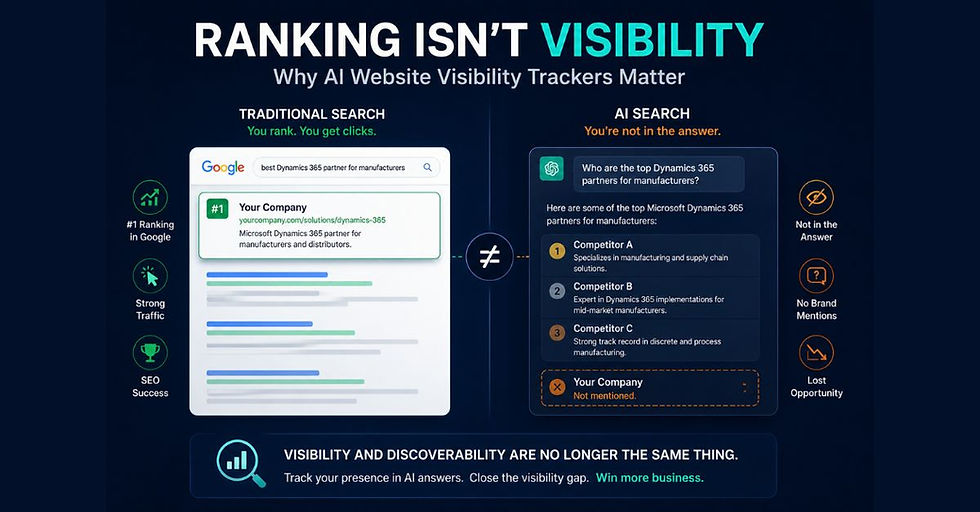
Most Microsoft Dynamics partners can tell you where they rank.
Few can tell you whether AI is recommending them.
That's becoming a problem.
Buyers are increasingly turning to ChatGPT, Google AI Overviews, Perplexity, Gemini, and other AI-powered search experiences for answers instead of sorting through pages of search results.
And while most marketing teams are still measuring rankings, traffic, and keyword performance, those metrics no longer tell the full story.
Because visibility and discoverability are becoming two different things.
A company can rank well in Google and still be absent from the answers buyers actually see.
Here's the shift:
Visibility is no longer determined solely by where you rank.
It's increasingly determined by whether AI includes you in the answer.
Picture this.
A prospect asks:
"What's the best ERP solution for a mid-sized manufacturer?"
Or:
"Which software vendor has the strongest AI capabilities?"
Within seconds, the AI delivers a recommendation.
Maybe two.
Maybe three.
But not ten.
If your company isn't included in that response, your ranking doesn't matter.
You're not part of the conversation.
That's the challenge many marketing teams are facing right now.
Traditional SEO tools can tell you where you rank. They can tell you how much traffic you're generating. They can tell you which keywords are driving visitors to your website.
What they can't tell you is whether AI platforms are mentioning your brand, citing your content, or recommending your expertise when buyers ask questions.
And that's creating a new measurement gap.
Because AI search is changing how discovery works.
The question is no longer:
"Do I rank?"
It's:
"Am I being recommended?"
That's why a new category of tools is emerging: AI website visibility trackers.
These platforms help businesses understand how often they appear in AI-generated answers, which content is cited, and how they compare with competitors in conversational search.
Because in the AI era, visibility isn't just about rankings.
It's about whether you're included in the answer at all.
Table of Contents
What Is an AI Website Visibility Tracker?
Most marketing teams have a visibility problem they can't see.
They know where they rank.
They know how much traffic they're generating.
They know which pages are performing well in search.
But ask a different question:
How often is ChatGPT recommending your company?
How frequently does Google AI Overviews cite your content?
Is Perplexity mentioning your competitors more than you?
For most organizations, the answer is simple:
They don't know.
And that's because the metrics they've relied on for years were built for a different search environment.
Traditional SEO tools were designed to measure visibility in search engines.
AI website visibility trackers are designed to measure visibility inside AI-generated answers.
Unlike traditional visibility tracking software, they're built to measure citations, mentions, recommendations, and share of voice across AI search platforms.
Think of them as a specialized AI visibility tool that helps organizations understand how often they're being cited, mentioned, and recommended across AI search platforms.
The metrics differ because the objective differs.
Traditional SEO focuses on:
Rankings
Traffic
Click-through rates
Backlinks
AI visibility focuses on:
Brand mentions
Citations and source references
Share of voice across AI platforms
Competitive visibility in AI-generated answers
Changes in AI visibility over time
Put differently:
Traditional SEO measures whether people can find you.
AI visibility measures whether AI recommends you.
That's the difference.
Many Microsoft Dynamics partners assume strong rankings automatically translate into AI visibility.
Increasingly, that's not true.
A company can rank first for an important keyword and still be absent from the answers buyers see in ChatGPT, Google AI Overviews, Gemini, or Perplexity.
That's creating a new measurement gap.
Because most reporting platforms were built to measure clicks.
Not citations.
Traffic.
Not recommendations.
Rankings.
Not visibility inside AI-generated answers.
And that's exactly why AI website visibility trackers are becoming an important part of the modern marketing stack.
7 AI Website Visibility Trackers Worth Evaluating
The market for AI visibility tracking tools is still young.
Unlike traditional SEO, there isn't a single platform that has become the default choice.
Most tools are solving different pieces of the same problem.
Some focus on AI citations.
Some focus on competitive visibility.
Others help marketers understand how AI platforms interpret and surface their content.
The right tool depends on what you're trying to learn.
Semrush AI Visibility Toolkit is one of the largest SEO platforms expanding into AI visibility tracking.
For organizations already using Semrush, it offers a way to monitor AI search performance alongside more traditional metrics such as rankings, traffic, and keyword visibility.
That's valuable because AI visibility doesn't exist in isolation.
Understanding how AI mentions, citations, and recommendations relate to your broader search performance helps create a more complete picture of discoverability.
Best for:
Organizations looking to integrate AI visibility measurement into an existing SEO reporting workflow.
Ahrefs approaches the problem from a brand visibility perspective.
Instead of asking where a page ranks, it focuses on how often a brand is being surfaced, mentioned, and referenced across AI-powered search experiences.
For companies trying to understand whether they're gaining or losing visibility against competitors, that's valuable insight.
Best for:
Organizations focused on brand awareness and competitive positioning.
Otterly was built specifically for AI search.
That focus makes it one of the more specialized tools in the category.
Rather than trying to be an SEO platform that also tracks AI visibility, Otterly starts with the assumption that AI search deserves its own reporting framework.
Best for:
Teams looking for a dedicated AI visibility platform.
Profound AI has gained attention because it goes beyond simple mention tracking.
The platform helps organizations understand how AI systems interpret, cite, and present their brand.
That's an important distinction.
Visibility isn't just about appearing.
It's about how you're being represented once you do.
Best for:
Organizations treating AI search as a strategic growth channel.
SE Ranking sits somewhere between traditional SEO and AI visibility.
It helps marketers understand where those two worlds overlap and where they don't.
For many teams, that's where the biggest opportunity exists.
Strong rankings don't always translate into strong AI visibility.
SE Ranking helps identify those gaps.
Best for:
Marketing teams transitioning from traditional SEO measurement to AI visibility measurement.
Rankscale AI focuses on measuring visibility across emerging AI ecosystems.
The platform emphasizes benchmarking and trend analysis, helping organizations understand whether their visibility is improving or declining over time.
That's particularly useful in a rapidly changing search environment.
Best for:
Organizations focused on long-term visibility trends.
Peec AI takes a simpler approach.
Rather than overwhelming users with reporting complexity, it focuses on helping marketers understand whether they're being surfaced across AI search experiences and how that visibility compares against competitors.
Sometimes that's all you need.
Best for:
Teams looking for straightforward AI visibility reporting.
The Metric Matters More Than the Tool
The tool matters.
But the metric matters more.
Many Microsoft Dynamics partners are still approaching AI visibility the same way they approached SEO a decade ago. They're looking for an AI ranking tool that tells them where they stand.
They're looking for rankings.
AI search doesn't work that way.
The question isn't:
"Where do I rank?"
The question is:
"Am I being cited, referenced, and recommended when buyers ask questions that matter to my business?"
That's the metric that ultimately determines visibility in an AI-first search environment.
Because buyers don't see your rankings.
They see the answer.
The Visibility Gap Most Teams Can't See
Many Microsoft Dynamics partners think they're visible because their SEO reports tell them they are. Their rankings look healthy, their traffic is growing, and their SEO visibility checker shows strong performance.
Their rankings look healthy.
Traffic is growing.
The website is generating leads.
On paper, everything looks fine.
But AI search is creating a new visibility gap.
A company can dominate traditional search and still be absent from the answers buyers actually see.
For years, they were closely connected.
Today, they're starting to diverge.

A buyer can ask ChatGPT for the best ERP solution for a manufacturer.
They can ask Google AI Overviews for guidance on evaluating Business Central partners.
They can ask Perplexity for recommendations.
And your company may never appear.
Not because your content is bad.
Not because your SEO is broken.
But because you're measuring the wrong signals.
The Four Signals That Actually Matter
Most organizations don't need more dashboards.
They need better questions.
When evaluating AI visibility, focus on four signals.

1. Recommendation Visibility
The first question isn't whether AI knows who you are.
It's whether AI recommends you.
If buyers ask questions related to your expertise, does your company appear in the response?
This is the closest thing AI search has to ranking.
Because buyers don't see a list of results.
They see recommendations.
2. Citation Authority
Being mentioned is good.
Being cited is better.
Citations indicate that AI systems view your content as credible enough to support the answer they're generating.
That's a stronger signal than visibility alone.
It suggests trust.
3. Competitive Presence
AI visibility isn't measured in isolation.
It's measured against alternatives.
If competitors consistently appear for the questions that matter to your business while your company doesn't, that's a visibility problem.
Even if your rankings look strong.
4. Topic Ownership
The goal isn't to appear everywhere.
The goal is to become associated with specific topics.
For Microsoft Dynamics partners, that might include:
Business Central
Copilot
Manufacturing ERP
Project accounting
Dynamics implementations
The strongest brands aren't visible across every conversation.
They're consistently visible in the conversations that matter.
Start Here
Before tracking dozens of metrics, answer one question:
When buyers ask questions related to our expertise, does AI recommend us?
Most organizations don't know.
And that's exactly why AI website visibility tracking exists.
How to Improve Your Visibility in AI Search
Tracking visibility is important.
Improving it is what actually moves the business forward.
The good news is that many of the signals AI platforms rely on aren't entirely different from those in traditional SEO.
The bad news is that many organizations are still optimizing for search engines rather than for answers.
That's an important distinction.
AI platforms aren't looking for the page with the highest keyword density.
They're looking for the source most likely to answer the user's question.
The organizations gaining visibility in AI search tend to have a few things in common.

They Answer Questions Directly
Most buyers don't search the way they used to.
They ask questions.
Specific questions.
Detailed questions.
Instead of writing content around keywords alone, build content around the questions buyers are actually asking.
For example:
"How do manufacturers improve inventory visibility in Business Central?"
"What are the benefits of Microsoft Copilot for finance teams?"
"Which Dynamics 365 solution is best for project-based businesses?"
The closer your content aligns with buyer questions, the easier it becomes for AI systems to surface it.
They Build Topic Authority
AI platforms don't just evaluate individual pages.
They evaluate expertise.
That's why isolated content rarely performs as well as a well-developed content ecosystem.
A single blog may answer one question.
A collection of related blogs, solution pages, case studies, FAQs, and resources helps establish authority around an entire topic.
Put differently:
The goal isn't to rank for a keyword.
The goal is to become a trusted source.
They Earn Trust Signals
Industry mentions still matter.
Brand authority still matters.
For years, these signals helped search engines determine credibility.
Today, they help AI systems determine which sources deserve to be cited and referenced.
Many marketers assume AI search has replaced traditional SEO.
In reality, it has amplified the importance of trust.
They Structure Content for Discovery
Great content isn't enough if AI platforms struggle to understand it.
Clear headings.
Logical organization.
FAQ sections.
Schema markup.
Supporting internal links.
These elements make content easier for both people and AI systems to interpret.
And the easier your content is to understand, the more likely it is to be surfaced.
Visibility Is Earned Before It's Measured
Many organizations start looking at AI visibility reports and immediately ask:
"How do we improve these numbers?"
That's the wrong first question.
The better question is:
"Why would AI recommend us in the first place?"
It's something you earn through expertise, authority, and content that genuinely helps buyers make decisions.
The tracking simply tells you whether the market is recognizing it.
What AI Visibility Tracking Looks Like in Practice
Let's say you're a Microsoft Dynamics partner specializing in manufacturing.
Your SEO reports look healthy.
You're ranking for terms like:
Dynamics 365 manufacturing ERP
Business Central manufacturing software
ERP for manufacturers
Traffic is growing.
Leads are coming in.
Everything appears to be working.
Then a prospect asks ChatGPT:
"What's the best ERP solution for a mid-sized manufacturer?"
Or they ask Google AI Overviews:
"Which Microsoft Dynamics partners specialize in manufacturing?"
And your company isn't mentioned.
A competitor is.
That's the visibility gap.

Traditional SEO reporting won't show it.
Your rankings haven't changed.
Your traffic hasn't dropped.
Nothing looks wrong.
But buyer discovery is happening somewhere your current reporting isn't measuring.
That's exactly what AI visibility tracking helps uncover.
Instead of asking:
"How many people clicked our website?"
You can start by asking:
"How often do we appear in AI-generated answers?"
"Which competitors are being recommended instead?"
"Which topics does AI associate with our brand?"
Those insights change how marketing teams prioritize content.
For example, you may discover that AI frequently references your company for Business Central implementation expertise but rarely mentions you when buyers ask about manufacturing solutions.
That's valuable information.
Not because it tells you what happened.
Because it tells you where the opportunity is.
When testing visibility manually, use an incognito browser window or a fresh AI session whenever possible.
AI platforms often personalize responses based on previous searches, prompts, location, and account activity.
If you're evaluating visibility, you want to see what a prospective buyer might see, not a version influenced by your own browsing history.
Many organizations approach AI visibility as a reporting problem.
The best organizations treat it as a strategic problem.
The Future of Visibility Is Different
For years, marketers measured success by their rankings.
That made sense when discovery started with a search engine and ended with a list of links.
But discovery is changing.
Buyers are increasingly turning to AI platforms to evaluate solutions, compare vendors, and find answers.
And those platforms aren't showing all the options.
They're making recommendations.
That's why AI visibility matters.
Not because SEO is dead.
Not because rankings no longer matter.
But because visibility and discoverability are no longer the same thing.
A company can rank well and still be absent from the conversations influencing buyer decisions.
That's the gap many organizations are only beginning to recognize.
The partners that adapt won't be the ones chasing every new AI trend.
They'll be the ones who understand how AI sees their business, where visibility gaps exist, and how to strengthen their authority over time.
Because the goal isn't simply to rank.
It's recommended.
And before you can improve that visibility, you have to measure it.
Most organizations worry about what AI is saying about them.
The bigger problem is not knowing whether AI is saying anything at all.
Not Sure How Visible You Are in AI Search?
Most Microsoft Dynamics partners have never measured their AI visibility.
They know where they rank.
They know how much traffic they're generating.
But they don't know whether ChatGPT, Google AI Overviews, Gemini, or Perplexity are recommending them when buyers ask questions related to their expertise.
That's exactly what our AI Visibility Audit is designed to uncover.
We'll help you understand:
Whether AI platforms are mentioning your business
Which topics does AI associates with your brand
Where competitors are gaining visibility
The biggest opportunities to improve your presence in AI search
Because before you can improve AI visibility, you need to know where you stand.
Frequently Asked Questions About AI Website Visibility Tracking
What is an AI website visibility tracker?
An AI website visibility tracker helps businesses understand how often they appear in AI-generated answers across platforms like ChatGPT, Google AI Overviews, Gemini, and Perplexity.
Unlike traditional SEO tools that measure rankings and traffic, AI visibility tools focus on citations, mentions, recommendations, and share of voice within AI-generated responses.
Why isn't traditional SEO reporting enough?
Traditional SEO tools were built to measure visibility in search results.
AI search changes the equation.
A company can rank well for important keywords and still be absent from AI-generated answers.
That's why many organizations are discovering a gap between ranking and visibility.
Can I check my AI visibility without a specialized tool?
Yes.
Start by asking AI platforms questions related to your products, services, and expertise.
For example:
Who are the top Microsoft Dynamics partners for manufacturing?
Which Business Central partners specialize in distribution?
What are the best Dynamics 365 solutions for project-based organizations?
When testing manually, use an incognito browser window or a fresh AI session whenever possible. You want to understand what a prospective buyer sees, not a response influenced by your own history, activity, or preferences.
What should I measure first?
Start with recommendation visibility.
Ask a simple question:
When buyers ask questions related to our expertise, does AI recommend us?
Before tracking dozens of metrics, determine whether you're showing up in the conversations that matter most.
Which AI visibility metric matters most?
There isn't a single metric that tells the whole story.
However, most organizations should focus on:
Recommendation visibility
Citation authority
Competitive presence
Topic ownership
Together, these signals provide a more complete picture of how AI platforms perceive your brand.
Does strong SEO automatically lead to strong AI visibility?
Not always.
Strong SEO can help create the authority signals AI systems look for, but rankings alone don't guarantee visibility in AI-generated answers.
Many organizations discover they're highly visible in traditional search while remaining largely absent from AI search experiences.
How often should I monitor AI visibility?
AI search is evolving rapidly.
For most organizations, monthly monitoring is enough to identify trends, competitive changes, and emerging opportunities.
The goal isn't to watch every mention.
It's to understand whether visibility is improving over time and whether AI is increasingly associating your brand with the topics that matter most to your business.
About Jon Rivers

Jon Rivers is the Co-Founder and COO of Marketeery. His technical background and sales and marketing skills enable him to understand solutions quickly and help drive more effective marketing campaigns. He's an international top-rated speaker. You can find Jon on LinkedIn.


