AI Search and Domain Authority: Why Backlinks Still Matter
Updated: Apr 16

Search is changing again.
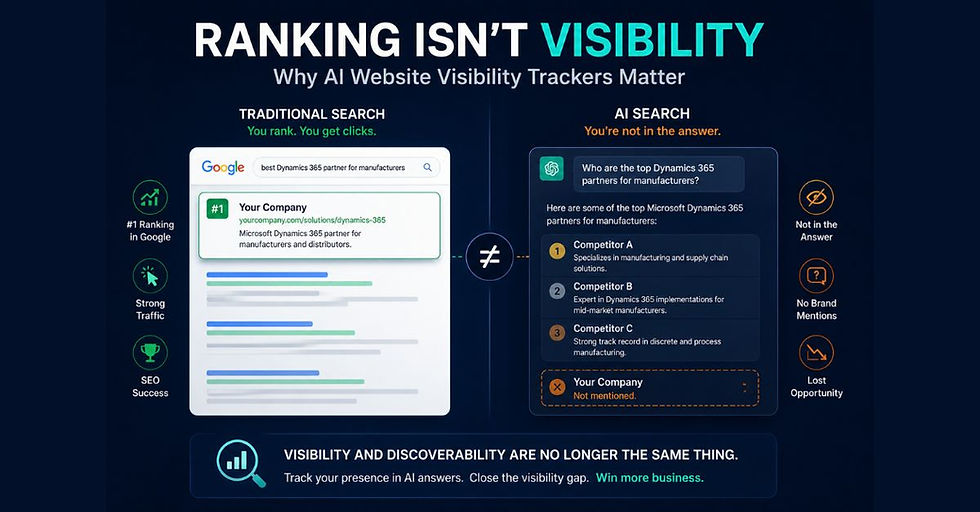
And this time, the shift is bigger than keywords, bigger than traffic, and bigger than Google.
For years, backlinks and domain authority were the backbone of SEO.
Write a strong blog → earn links → climb to page one.
Microsoft Dynamics Partners followed the playbook.
Dynamics ISVs lived by it.
But the way buyers look for answers has fundamentally changed.
This shift isn’t theoretical.
Gartner research shows that nearly half of B2B buyers are already using AI during the purchase process, with buying journeys becoming more self-directed and digitally mediated.
They’re not typing “Dynamics 365 project accounting add-on” into Google anymore.
They’re asking Copilot, ChatGPT, Gemini, or Perplexity:
This shift toward natural-language questions is what’s driving visibility changes. If your content isn’t aligned with conversational queries, you won’t get surfaced.
“Which Dynamics 365 ISV can help me improve project profitability?”
“What’s the best solution for manufacturers using Business Central?”
And here’s the part every Microsoft Dynamics Partner should pay attention to:
AI tools don’t return lists.
They return answers.
If you’re still thinking in terms of rankings and page position, you’re missing the shift entirely. We break that down in detail in our guide to AI Search vs. Traditional Search.
If your content isn’t trusted enough to be in the answer, you’re invisible.
And that raises a critical question many partners are now asking:
Do backlinks still matter in an LLM-driven world?
Yes, maybe more than ever.
Because backlinks and domain authority have evolved from “Google ranking signals” into AI trust signals.
They help large language models understand whose content is credible enough to cite, recommend, and surface in front of your buyers.
Let’s break down exactly what that means and why authority matters more, not less, in the age of AI-powered search.
Table of Contents
Why Backlinks Still Matter in an AI-First World
There’s a dangerous myth circulating in partner conversations: “AI changed search… so backlinks don’t matter anymore.”
Not true.
If anything, backlinks have become even more important.

Here’s why:
AI Needs Trust Signals
Microsoft Copilot, ChatGPT, Gemini, and Perplexity aren't randomly pulling content from across the internet.
They’re trained to prioritize sources with authority.
Backlinks help LLMs understand:
“This source is legitimate.”
“This voice is trusted.”
“This content is safe to recommend.”
Citations Drive Visibility
When an AI assistant cites content, it’s not because you used the right keyword.
Selection isn’t random. It follows clear structural patterns. We break down exactly what gets cited in our guide to What Content Ranks in AI Overviews.
It’s because your domain has been externally validated.
Backlinks are the digital endorsements that tell AI models:
This content is credible.
This company is reputable.
This answer can be trusted.
Authority Determines Influence
In the Microsoft Dynamics ecosystem, hundreds of blogs cover cash flow, job costing, inventory, and migrations. But only a few have true authority, and that’s who AI leans on.
Backlinks are how you get a seat at that table.

Without them, your content might perform “okay” in Google.
But in AI search, where only one or two answers matter, authority becomes everything.
The Role of Domain Authority in AI Search
Backlinks are the building blocks.
Domain authority is the bigger picture.
Traditional SEO rewarded domain authority with higher rankings.
But AI search raises the stakes:
Google rewards rankings.
LLMs reward trust.
AI assistants don’t show 10 results.
They show one.
If your domain isn’t considered authoritative, you don’t just rank lower; you disappear from the answer set entirely.
Authority in the Dynamics Ecosystem
When a buyer asks Copilot: “Which ISVs help manufacturers optimize inventory in Business Central?”
The model evaluates:
Does this site consistently publish credible content?
Do other industry sites reference or link to it?
Do authors demonstrate expertise?
Does the content directly answer the question?
If the answer to any of these is “no,” the model chooses someone else.
Domain authority isn’t a nice-to-have.
It’s your credibility score in the AI era.
How Backlinks and Trust Signals Influence LLM Behavior
LLMs prioritize four ingredients when selecting sources:
1. Relevance
Does your content match the buyer’s intent?
2. Authority
Do trusted sites link to you?
3. Clarity
Is the content structured in a way that an AI can easily interpret?
4. Consistency
Do you show up across the community with the same expertise?
This is why authority matters more now than during the keyword era.
Example
A CFO asks ChatGPT: “Which Dynamics 365 ISV solutions help improve cash flow forecasting?”
The AI looks across data sources.
It sees which Dynamics ISVs:
have backlinks from sites like G2, ERP Software Blog, MSDynamicsWorld, The Partner Index
publish well-structured content
demonstrate ongoing expertise
have strong on-domain authority signals
If your content lacks these signals, even if your blog is well written, it gets skipped.
Backlinks are no longer just for ranking.
They’re for recognition.
Why Dynamics Partners Can’t Ignore Authority Signals
Competition in the Dynamics channel is fierce.
Dozens of ISVs solve the same problem: credit cards, job costing, inventory, data integration, field service… the list goes on.
Most partners aren’t even building the content foundation required for authority. Our analysis of 75+ Business Central partners shows just how wide that gap really is.
So why does one partner consistently surface in AI search while others remain invisible?
Authority signals.
Here’s what that looks like:
Industry Backlinks
Links from respected publications tell AI: “These people are known. These people are credible.”
Thought Leadership
Publishing regularly on LinkedIn, community sites, and industry events reinforces your expertise.
Content Citations
When other partners or industry voices reference your content, your authority grows exponentially.
Credible Author Profiles
AI doesn’t just look at what’s written, it looks at who it’s coming from.
Named experts with clear experience in the Dynamics ecosystem carry more weight than anonymous blog posts.
Think:
practice leaders
MVPs
solution architects
long-time consultants
recognized voices
Add short, specific bios to your content that highlight:
years in the channel
product focus (Business Central, F&O, CE, etc.)
industry focus (manufacturing, distribution, services)
speaking, community, or user group involvement
A faceless page can’t compete with content that clearly comes from a real, trusted expert.
Partners who consistently invest in authority become the ones AI recommends first.
Those who don’t?
They’re filtered out long before the buyer ever sees them.
How to Build Authority for AI Search: A Playbook for Dynamics Partners
The good news:
You don’t need 1,000 backlinks or giant corporate budgets.
You need relevant authority.
Here’s the playbook:
1. Target Industry-Relevant Backlinks First
Go after the sites AI already trusts. For example:
ERP Software Blog
CRM Software Blog
MSDynamicsWorld
The Partner Index
Partner guest posts
Random backlinks won’t help you. Context matters.
2. Publish Content Worth Citing
LLMs love citing:
original data
published frameworks
comparison guides
industry insights
benchmark reports
Give the community something to reference, AI will notice.
3. Strengthen Author Profiles
Every blog should have a clear author:
credentials
years in the channel
areas of expertise
AI increasingly weighs author identity when selecting trustworthy sources.
4. Build Internal Linking Depth
Internal links tell AI: “This site has breadth and expertise on this subject.”
This is exactly why a connected content system matters. Your blogs should reinforce each other, not sit in isolation. We break down how to structure that system in our guide to AI search optimization.
Link blogs → case studies → solution pages → related insights.
5. Show Up in the Community
Speak, post, collaborate.
AI recognizes names that consistently appear across the ecosystem.
6. Test Your Visibility in AI Tools Regularly
Ask AI the exact questions your buyers ask:
“Which Dynamics ISVs help reduce production costs?”
“What’s the best project accounting solution for Business Central?”
If you’re not in the answer, you know where to focus.

Domain Authority + LLM Citations: How the Pieces Fit Together
Traditional SEO focused on ranking.AI search focuses on confidence.
Backlinks → raise domain authority
Domain authority → reinforces AI trustAI trust → increases citation likelihood
Citations → reinforce authority signals back into the ecosystem
It’s a feedback loop.
The more authoritative you become, the more AI is willing to use your content, which makes you even more authoritative.
Dynamics Partners who invest now will dominate AI-powered visibility later.
Building AI-Ready Backlinks: What Works Best for Dynamics Partners
1. Industry Authority Sites
Your fastest path to trust. AI already recognizes them.
2. Leverage the Microsoft Ecosystem
AppSource
Partner directory
Microsoft docs cross-references
Co-marketing or co-publishing
Context + proximity to Microsoft increases trust signals.
3. Use the Community as a Backlink Engine
User group recaps
Guest features
Partner collaborations
Webinar summaries
Every time someone references you, your authority grows.
4. Case Studies Are Link Magnets
Buyers trust outcomes. AI trusts evidence.
5. Prioritize Quality Over Quantity
One link from MSDynamicsWorld > fifty from low-authority blogs.
6. Repurpose Everything
Every webinar → recap blog → partner link → community post.
More touchpoints = more signals.
Measuring Whether Your Backlink Strategy Is AI-Ready
Traditional SEO metrics matter, but now you need new AI-readiness checks.
1. Track Domain Authority + Referral Traffic
Look at who’s linking to you and who’s sending meaningful traffic.
2. Test Your Visibility in AI Tools
Ask the questions buyers ask daily.
If you aren’t listed your authority signals aren’t strong enough.
3. Use LLMS.txt & Schema Markup
LLMS.txt and structured data make it easier for AI to interpret your content.
While still emerging, frameworks like LLMS.txt are already gaining traction across platforms and SEO tools. Semrush provides a helpful breakdown of how LLMS.txt works and why it matters.
4. Watch for AI Citations
Perplexity and other tools occasionally cite sources directly.
If you’re being cited you’re on the right track.
5. Balance Short-Term SEO with Long-Term Authority
SEO brings traffic.
Authority earns trust.
AI search demands both.
Final Action Plan for Partners and ISVs
Here’s the bottom line:
Backlinks aren’t “old SEO.”They’re the new trust signal of AI search.
To stay visible:
Audit your backlink profile
Build authority where buyers already go
Optimize for AI interpretation
Create content worth citing
Test your visibility in Copilot and ChatGPT
Authority is the new ranking.
And in a world where AI returns only one answer, the partners who invest in authority now will be the ones buyers see first every time.
Frequently Asked Questions (FAQ)
Do backlinks still matter in an AI-driven search world?
Yes, and arguably more than before.
Backlinks still signal credibility to Google, but in an AI-first world, they also act as trust markers that help Copilot, ChatGPT, Gemini, and Perplexity determine which sources are safe to reference.
If your domain earns consistent, high-quality backlinks, AI models are far more likely to pull your content into their answers.
How do AI tools evaluate authority compared to Google?
Google evaluates authority through measurable ranking signals backlinks, domain authority, site quality, user behavior, and technical SEO.
AI tools evaluate authority differently:
They analyze context, clarity, and topical expertise
They look for consistent signals across the web
They rely on trusted domains and recognizable authors
They prioritize content that directly answers buyer questions
Google decides who ranks. AI decides who gets quoted.
What backlinks carry the most weight for Dynamics partners?
Industry relevance matters more than raw volume.
The most powerful backlinks come from sites AI already recognizes as credible in the Microsoft channel, such as:
User group recaps
Partner-to-partner content collaborations
A single backlink from a well-known Dynamics publication outweighs dozens of links from generic business directories.
Do AI citations replace backlinks?
Not at all, they complement them. AI citations are a result of trust.
Backlinks are one of the key inputs that build that trust.
Think of it this way:
Backlinks → authorityAuthority → AI confidenceAI confidence → citations
Citations don’t replace backlinks; they reinforce the need for them.
How can smaller ISVs compete with big partners on authority signals?
By focusing on niche authority instead of broad dominance.
Smaller ISVs win when they:
publish content tailored to a specific vertical or problem
earn backlinks from highly relevant industry sites
showcase founder or expert-level authorship
publish original insights, frameworks, and examples
show up consistently across community channels
You don’t need to outrank Microsoft.com; you just need to be the most trusted expert in your specialty.
How do I know if AI is picking up my content?
Test it directly — the same way your buyers would.
Ask Copilot, ChatGPT, Gemini, or Perplexity questions like:
“Which Dynamics 365 ISVs help with cash flow forecasting?”
“What’s the best project accounting add-on for Business Central?”
“Which partners help manufacturers reduce production costs in Dynamics 365?”
If your company isn’t mentioned, the AI may not:
understand your content
trust your authority signals
connect your pages to buyer intent
That’s your signal to strengthen domain authority, refine content clarity, and build more relevant backlinks.
Ready to See Whether AI Trusts Your Content?
If you want to understand how your authority signals stack up and how to strengthen them, Marketeery can help.
If you’re not showing up in AI answers today, it’s not a content problem. It’s a visibility system problem.
Book a free AI Search Authority Check-Up, and we’ll show you:
whether your content is being surfaced in AI today
where competitors are earning trust signals you’re missing
the fastest ways to strengthen your AI-ready authority profile
AI search isn’t about ranking. It's about being chosen. Let’s make sure you are.
About Jon Rivers

Jon Rivers is the Co-Founder and COO of Marketeery. His technical background and sales and marketing skills enable him to understand solutions quickly and help drive more effective marketing campaigns. He's an international top-rated speaker. You can find Jon on LinkedIn.