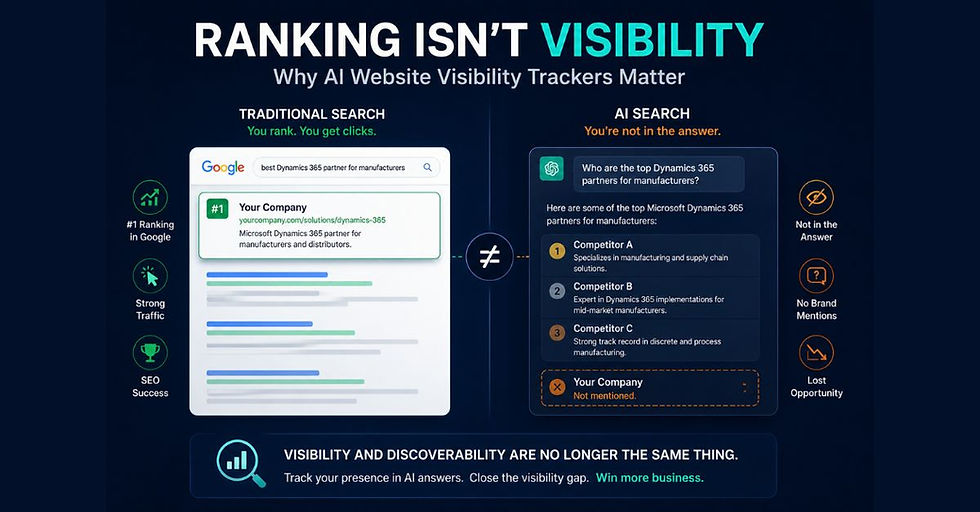
AI Search for Dynamics Partners: How Agents and Context Will Redefine Discovery


Search isn’t just changing; it’s getting personal.
And for Microsoft Dynamics partners and ISVs who depend on being discovered, that shift changes everything.
For years, we played by Google’s rules: build backlinks, choose the right keywords, and fight for page-one visibility. That strategy worked until it didn’t.
Today, your buyers aren’t typing keywords into search bars.
They’re talking to AI assistants like Copilot, ChatGPT, and Gemini.
And those assistants don’t deliver 10 blue links.
They give one conversational answer.
That’s the new reality: AI doesn’t list results; it recommends relationships.
These AI agents are reshaping how discovery happens.
They understand context, interpret intent, and personalize every response based on the user’s role, data, and behavior.
Imagine a CFO asking Copilot:

That question won’t trigger a list of results; it will trigger a recommendation.
One informed by authority, trust, and relevance.
So, here’s the challenge: visibility isn’t just about SEO anymore.
It’s about teaching AI who you are, what you know, and why your expertise matters.
In this blog, we’ll explore how to make sure you’re in the answer when buyers ask those questions:
How AI agents like Copilot and ChatGPT are becoming the new gatekeepers of discovery.
Why context and personalization are replacing traditional keywords.
What Microsoft Dynamics partners and ISVs can do right now to stay visible in this AI-first search era.
Because the future of marketing in the Microsoft ecosystem won’t belong to the loudest voice, it’ll belong to the most discoverable one.
The Evolution of AI Search: From Queries to Conversations
Search used to be simple.
Buyers typed a few keywords, hit enter, and sifted through a list of links.
Whoever ranked highest won the click.
That world doesn’t exist anymore.
Today, search is a conversation.
AI tools like Copilot, ChatGPT, and Gemini don’t just look for matching phrases; they interpret intent.
They listen to how a question is asked, who’s asking it, and what business context surrounds it.
And that context changes everything.
From Search Results to Smart Recommendations
Think about how Dynamics buyers used to search:
“Dynamics 365 project accounting add-on.”
The result?
Ten blue links, a few AppSource listings, and some vendor blogs.
The buyer had to figure out what was relevant.

Now, that same buyer opens Copilot inside Business Central and asks:
“How can I improve project profitability in Microsoft Dynamics 365 Business Central?”
Instead of a list, Copilot delivers a summary, recommendations, and if your content has the right authority, your solution.
That’s not a search.
That’s discovery.
It’s a search that understands roles, relationships, and business context.
A CFO gets a different answer than a controller. A manufacturing buyer gets a different one than a service-based firm.
Why It Matters for Microsoft Dynamics Partners
For Dynamics partners and ISVs, this shift means one thing: You’re not optimizing for keywords anymore, you’re optimizing for understanding.
AI-driven search rewards content that mirrors how people naturally talk and think.
It prioritizes clarity, expertise, and context.
It learns from how buyers engage, not just what they type.
If you're still thinking about visibility through the lens of rankings, our guide on AI Search vs. Traditional Search breaks down how buyer discovery is changing and what it means for Dynamics partners.
According to Gartner, more than 67% of B2B buyers now begin their research in AI-powered tools like ChatGPT or Copilot, bypassing traditional search altogether.
That’s why it’s not enough to rank on Google anymore.
You need to be in the conversations happening within AI tools, the ones where decisions are being made.
This new world of AI discovery isn’t just technical.
It’s relational.
It’s about building trust with the algorithms and the people behind them.
Because when a buyer asks:
“What Microsoft Dynamics 365 Business Central add-on solutions help manufacturers reduce production costs?”
AI won’t show 10 options unless you ask it to. It’ll show one or two of the ones it trusts.
And the question every partner should be asking right now is simple: Will it be you?
Let’s unpack what’s driving that shift: the rise of AI agents and contextual discovery.
AI Agents and the Rise of Contextual Discovery
AI agents are changing how people find, compare, and decide what to buy.
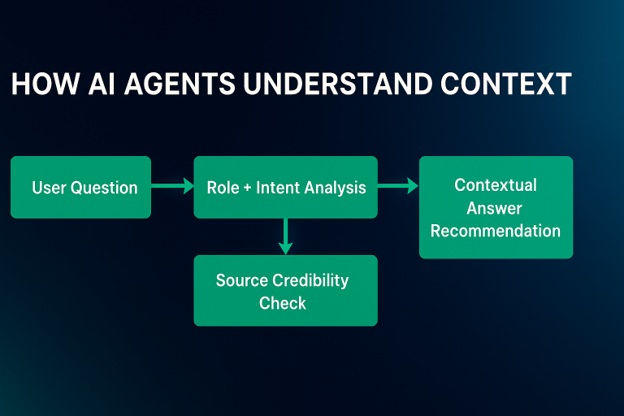
They don’t just locate information; they interpret intent.
They act more like digital advisors, understanding what buyers mean, not just what they type.
They anticipate next steps and deliver insights that fit the user’s role, preferences, and business context.
Think of Microsoft Copilot as your buyer's first consultant. It's already embedded across Microsoft 365 applications like Outlook, Teams, and Dynamics 365, helping users find information, generate insights, and take action.
When a CFO asks,
“What are the top solutions that can improve our project profitability?”
Copilot doesn’t just list apps.
It draws on trusted sources, cross-references Microsoft data, and surfaces the most relevant answers.
That’s contextual discovery search that understands what matters in the moment.
From Keywords to Context
Traditional SEO was built to win the click.
Contextual discovery is built to earn the recommendation.
AI agents like Copilot, ChatGPT, and Gemini evaluate more than your keywords.
They look at:
Who your content serves and how clearly you explain it
Where your expertise shows up across the web
What other credible sources say about you
If your content is consistently helpful, relevant, and backed by authority links, AI begins to treat you like a trusted voice, not just another vendor.
That’s when your content stops competing on Google and starts appearing in AI-powered answers and summaries, where your buyers are now making decisions.
Of course, not all content is equally likely to be surfaced. Certain formats, structures, and content types are cited more frequently than others. We break down those patterns in our guide to what content ranks in AI Overviews, ChatGPT, and Copilot.
Why Context Matters More Than Ever
In the Microsoft Dynamics ecosystem, context is currency.
A manufacturing operations leader searching inside Copilot expects different insights than a project-based services firm using ChatGPT.
AI tools are learning to personalize results based on role, industry, and intent, blending users' queries with what their systems already know.
That means your content can’t just describe what your solution does; it needs to explain why it matters, who it helps, and how it solves real-world problems.
Examples of context-rich content include:
“How Dynamics 365 Field Service Reduces Downtime for Construction Firms”
“Top 3 Dynamics 365 ISVs Helping Distributors Improve Cash Flow Forecasting”
“What Every CFO Should Know Before Migrating from Dynamics GP to Business Central”

These aren’t just blog topics.
They’re signals that help AI understand who you serve, what problems you solve, and where your expertise fits.
The shift is already underway. Gartner predicts that by 2028, at least 70% of customer service journeys will begin and end with conversational AI, highlighting how quickly users are moving toward AI-powered interactions and discovery.
That means the content you publish today is helping shape how AI agents like Copilot interpret, evaluate, and recommend solutions tomorrow.
When AI models look for insights to surface, they prioritize authority, clarity, and context, not clever keywords.
That’s how you move from being a vendor to becoming the trusted answer.
The Partner Opportunity
This shift isn’t something to fear; it’s the biggest opportunity Microsoft Dynamics partners and ISVs have had in years.
You already operate in an ecosystem where context drives success.
Your expertise lies at the intersection of industry processes and technology, the exact space AI agents now optimize for.
By publishing content that mirrors real buyer intent- “How do I improve visibility in Dynamics 365 Business Central?” instead of “Dynamics 365 visibility tools,” you train AI to connect your name, your expertise, and your solution with the question itself.
This shift from keywords to natural-language questions is exactly why conversational queries are becoming such an important part of modern search visibility.
That’s how you get discovered in the new search landscape.
Not through volume, through contextual relevance and trust.
Because soon, the real question won’t be:
“Can buyers find us on Google?”
It’ll be:
“Does Copilot trust us enough to recommend us?”
Personalization and the Human Side of AI Search
AI isn’t just making search smarter.
It’s making it personal.
The same way Dynamics 365 connects finance, operations, and sales data to create a unified customer view, AI-powered search is doing the same for how people discover and evaluate solutions.
When your buyers interact with Microsoft Copilot, ChatGPT, or Gemini, they don't all see the same results.
Each answer is shaped by who they are, what they’ve asked before, and the context of their role.
That’s personalization in action and it’s redefining discovery.
From Generic Search to Personalized Insight
In traditional search, everyone started from the same place: type a keyword, get a list of links.
Now, every query is unique.
Copilot, for example, tailors responses using signals from Microsoft 365 apps, emails, and chats. ChatGPT considers the user’s past prompts and tone.
Gemini learns from interaction history across Google’s ecosystem.
That means when a CFO types:
“Best Dynamics 365 ISVs for project profitability,”
they’ll get a very different answer than an IT Director asking:
“What integrations do I need to connect Dynamics 365 Business Central with Power BI?”
Each user gets the most relevant answer for their goals, not a generic list of options.
As a result, the future of search isn’t about visibility alone, it’s about relevance to the individual.
The Personalization Equation
For Dynamics partners and ISVs, personalization means more than audience segmentation.
It’s about aligning content with buyer intent and demonstrating real empathy for their role and challenge.
When AI agents interpret a question, they weigh three key factors:
Intent – What is the user really trying to solve?
Context – What do they already know or use (industry, role, system)?
Authority – Who do they trust to answer correctly?
If your content aligns with all three, you become part of the personalized experience.
That’s why it’s no longer enough to write “Top 10 Dynamics 365 Features.”
You need to publish content like:
“How CFOs Can Streamline Financial Reporting with Dynamics 365 Business Central”
“3 Common Data Pitfalls IT Leaders Face Integrating Dynamics 365 and Power BI”
“How Operations Managers Use Copilot to Reduce Manual Work in Supply Chain Management”
Each one speaks directly to a persona, which makes it both human-friendly and AI-discoverable.
Why Humanization Is the Future of AI Search
Ironically, as AI gets smarter, the brands that win will be the ones that feel most human.
Buyers may start their journey with AI tools, but they still make decisions based on trust, and trust comes from authentic voices, thought leadership, and stories that resonate.
That’s why your brand voice, author bios, and credibility signals matter more than ever.
When AI tools like Copilot or Gemini cite a source, they evaluate:
Consistency – Do you publish regularly on the topic?
Authenticity – Is your content authored by real people with expertise?
Clarity – Does your writing reflect empathy and understanding?
These are the new human SEO signals that tell AI that your insights are credible and relatable.

The Human + AI Trust Loop:
Human experts create credible content. AI ingests that content, uses it to answer questions, and recommends trusted brands more often.
As buyers engage and share, your authority grows—feeding better signals back into AI.
Microsoft Partners Have a Head Start
Here’s the advantage: Microsoft Dynamics partners and ISVs already know their customers’ world inside and out.
You talk to CFOs, COOs, and project managers every day.
You understand the language they use and the problems they’re solving; that’s the exact context AI is trying to replicate.
By turning those real conversations into structured content, you give AI models the human nuance they’re missing.
That’s what turns your expertise into data AI can trust.
How to Build for Personalization and Trust
Here’s how Dynamics partners can make sure their content connects with both AI and real humans:
Add Clear Author Profiles
Include real names, roles, certifications, and experience.
Example: “Written by Jane Smith, CPA, 10+ years implementing Business Central for manufacturers.”
Write for Roles, Not Keywords
Use conversational language that mirrors how buyers talk.
Instead of “Dynamics 365 manufacturing ERP add-on,” try “How manufacturers use Dynamics 365 to track production costs.”
Show Empathy in Every Post
Address the pain point before the pitch.
Example: “If you’re tired of chasing data across disconnected systems…”
Feature Real Stories
Use customer examples, partner collaborations, or event insights.
These add emotional credibility, something AI can detect through tone and phrasing.
Feed AI the Right Context
Update metadata, schema, and LLMS.txt (where applicable) to make it easier for AI to connect your content to your expertise.
The Bottom Line
AI search is becoming personal.
Your next buyer won’t just search for you; they’ll talk to AI about their needs.
And whether your solution shows up depends on how well your content aligns with their context, role, and trust network.
The Dynamics partners who humanize their content today will become the ones AI recommends tomorrow.
Because when everyone has access to the same technology, the human side of your brand becomes the ultimate differentiator.
The Evolution of Multi-Modal Search (Text, Voice, Image, and Beyond)
Search is no longer a single box on a screen.
It’s becoming a conversation that happens through any medium- voice, image, text, or even screenshots.
AI is transforming how buyers ask questions, not just how they find answers.
In this new world, someone exploring Dynamics 365 might not type a query at all.
They might speak into Copilot, share a dashboard screenshot, or upload a spreadsheet, and the AI interprets it instantly.
That’s the next frontier: multi-modal search.

And it’s redefining how Dynamics partners and ISVs get discovered.
What Multi-Modal Search Really Means
“Multi-modal” means a search that understands multiple forms of input text, speech, images, and data, all working together.
Tools like ChatGPT with vision, Microsoft Copilot for Microsoft 365, and Google Gemini Advanced are already leading the way.
Here’s what that looks like in action:
A CFO uploads a screenshot of a confusing cost report and asks Copilot, “Can you show me where my project margins are slipping?”
An operations manager takes a photo of an inventory dashboard and asks, “Which items are running low across all sites?”
A Dynamics consultant drops a table from Excel into Copilot and says, “Summarize key cash flow trends and suggest next steps.”
Each of these prompts starts with different data, but the intent is the same: to get a clear, contextual answer without manual searching.
Why This Matters for Microsoft Dynamics Partners
For partners and ISVs, this shift isn’t just a tech trend; it’s an opportunity for visibility.
Your buyers will soon rely on AI agents that see and hear context, not just read it.
That means your content blogs, demos, screenshots, and even videos become data for AI to analyze.
The more structured, descriptive, and accessible it is, the easier it becomes for Copilot or ChatGPT to surface it when users interact visually or verbally.
Imagine a buyer asking Copilot:
“Show me solutions that can analyze these project cost overruns inside Business Central.”
If your site includes clear visuals, alt-text with keyphrases (“Dynamics 365 project cost management”), and schema markup identifying your product as a “solution,” you dramatically increase your odds of showing up.
This is the evolution from search engine optimization to signal optimization.
Preparing for a Voice-First, Visual-Ready World
The next generation of AI search will listen, watch, and interpret.
That means your content strategy needs to follow three principles:
Optimize Visuals Like Text
Add descriptive alt-text using your focus keywords.
Label images clearly: dashboards, workflows, process charts.
Example: “Screenshot of Dynamics 365 Business Central project costing dashboard highlighting margin trends.”
Embrace Voice and Conversational Prompts
Write titles and headings that mirror how buyers speak.
Example: instead of “ERP for Service Firms,” try “How Service Firms Use Dynamics 365 to Manage Projects.”
Make Videos Searchable
Add transcripts, captions, and summaries.
Use schema markup so AI knows your video explains “Dynamics 365 Copilot in Manufacturing.”
These steps aren’t cosmetic; they’re how AI learns to see your content.
How AI Uses Context Across Inputs
Multi-modal search isn’t just about more ways to ask questions; it’s about combining signals.
When an AI agent sees a screenshot from Business Central, hears a question about profitability, and recognizes your brand from prior queries, it fuses those inputs to deliver a personalized, confident answer.
That means brand familiarity and content accessibility now influence how visible you are within AI ecosystems.
The more ways your brand shows up- text, voice, visuals- the more confident AI becomes in recommending you.
Opportunities for Dynamics Partners and ISVs
Multi-modal discovery opens several new marketing plays:
Interactive Demos: Create short videos or GIFs showing your ISV solution in action. These are gold for AI crawlers.
Visual Case Studies: Replace walls of text with annotated screenshots and captions—AI reads those cues.
Voice-Friendly Blogs: Record short voice notes or podcast clips summarizing your key insights.
Data-Driven PDFs: Ensure downloadable guides include alt-text, tables, and structured headings so AI can parse them.
The partners who prepare now will dominate when AI search becomes fully multi-modal.
Because soon, your buyers won’t just be reading about you; they’ll be showing, asking, and hearing about you, too.
The Bottom Line
AI search is evolving beyond keywords and clicks; it’s becoming multi-modal, contextual, and personalized.
For Microsoft Dynamics partners, this is your signal to think bigger than content.
Think interaction.
Your next buyer might not find you through Google; they might discover you through a Copilot conversation, a screenshot, or even a voice command.
The partners who adapt early will be the ones AI sees, understands, and recommends first.
Action Plan: How Dynamics Partners Can Prepare for the Next Era of AI Search
Let’s get practical.
The future of AI search isn’t some distant vision, it’s unfolding right now.
Every time someone asks Copilot, ChatGPT, or Gemini a question about Dynamics 365, the AI decides which voices to trust and whose content to surface.
If your brand isn’t preparing for that shift, you’re leaving visibility and deals on the table.
So, how do you future-proof your marketing for AI search, multi-modal discovery, and agent-driven personalization?
Here’s the roadmap.
1. Build Trust Signals That AI Can See
Authority is still the currency of visibility, only now, it’s AI that’s doing the counting.
Earn backlinks from trusted Dynamics publications like ERP Software Blog, MSDynamicsWorld, and The Partner Index.
Publish under real names with verified author bios (LinkedIn, Microsoft partner credentials, certifications).
Cross-link your best content across your blogs, AppSource listing, and partner directory pages.
Every one of these signals reinforces credibility with both search engines and AI models that decide which content to recommend.
Quick Win: Add structured data (schema) for “Software Application” and “Case Study” on your top pages.
It’s a small step that makes a big difference in how AI interprets your authority.
2. Optimize for AI Assistants, Not Just Google
Copilot and ChatGPT don’t scroll.
They summarize.
That means your content needs to read more like an answer than a blog.
Use clear, structured headers that match natural language queries.Include short summaries at the top of each section.End with concise takeaways that sound like “advice Copilot would give.”
For example:
Instead of this:
“Dynamics 365 offers tools for managing inventory.”
Try this:
“If you’re using Dynamics 365 to manage inventory, start by automating reorder levels and using Copilot to surface demand insights. It saves time and reduces waste.”
AI doesn’t just read it learns tone and intent.
The more conversational and actionable your writing, the more likely it gets picked up in AI-generated answers.
3. Create Multi-Modal, AI-Readable Content
Text isn’t enough anymore.
Start treating every piece of visual or audio content like a searchable asset:
Add alt-text that includes context and keywords (“Dashboard view of Dynamics 365 Business Central cash flow forecasting”).
Upload transcripts for webinars and podcasts.
Publish slide decks and infographics with descriptive captions and summaries.
Label images and videos with schema so AI can parse and connect them.
Remember: AI reads images like humans read headlines. Make yours count.
4. Test Your Visibility Inside AI Tools
Don’t guess test.
Use AI tools like your buyers would:
Open ChatGPT, Copilot, or Perplexity and ask:
“Which ISV helps manufacturers with job costing in Dynamics 365 Business Central?”
“Best partner for migrating from Dynamics GP to the cloud.”
“Top Dynamics 365 apps for financial reporting.”
If your brand doesn’t appear, that’s your cue.
Analyze what content does show up what topics, tone, and trust signals those results use and adjust your strategy accordingly.
Quick Win: Run these tests quarterly and log results like SEO audits. Over time, you’ll see where your AI presence grows.
5. Humanize Your Expertise
The irony of AI search is that the most “machine-driven” systems now reward the most human voices.
Put your people forward, your thought leaders, consultants, and experts.
Add author photos and bios to every blog.
Encourage your team to post on LinkedIn using real experiences.
Quote customer success stories in conversational, relatable ways.
When Copilot or ChatGPT scans your site, it’s not just pulling information — it’s assessing authenticity.
And nothing feels more authentic than a real person sharing insights in their own words.
Quick Win: Publish one “human perspective” post each month a story, lesson, or behind-the-scenes insight. It gives your brand the voice AI can recognize and trust.
6. Track New Metrics: AI Visibility, Not Just Traffic
Traditional SEO metrics still matter, but now you also need to measure how visible your brand is within
AI ecosystems.
Start tracking:
AI Mentions & Citations: Use tools like Perplexity or ChatGPT Pro to see where your brand is cited.
AI Ranking Presence: Record whether you’re appearing in Copilot summaries or Gemini responses.
Engagement Beyond Clicks: Track how many of your backlinks drive qualified referrals, not just traffic.
Pro Tip: Use “LLMS.txt” to guide AI crawlers to the content that best represents your brand. It’s early-stage tech, but being an early adopter signals authority.
7. Keep Experimenting
The AI landscape changes monthly. Partners who stay curious will stay ahead.
Try this:
Repurpose a whitepaper into a ChatGPT-optimized FAQ format.
Add AI search snippets to your resource pages.
Host a “Copilot Clinic” for your team to explore prompts and discover how your content appears.
Every experiment helps you understand how buyers and AI agents interpret your expertise.

The Bottom Line
AI search isn’t coming; it’s here.
Your buyers are already asking Copilot and ChatGPT for the answers your business provides.
The question is: will they find you in those answers?
Microsoft Dynamics partners and ISVs who act now, building trust signals, optimizing for AI, and creating human-centered content, won’t just survive this shift.
They’ll lead it.
Because in the next era of search, authority won’t be bought or built overnight.
It’ll be earned through credibility, consistency, and context.
Frequently Asked Questions (FAQ)
What exactly is an “AI agent,” and how does it differ from standard AI search?
AI agents are autonomous assistants that do more than retrieve information; they interpret intent, fetch data, and even take actions on behalf of users.
While standard AI search returns results based on queries, agents understand context, follow-up questions, user preferences, and interact dynamically with data systems (e.g., inside a Dynamics environment).
How does contextual search change the way buyers interact with content?
In contextual search, AI doesn’t just see the words you typed; it sees who’s asking, where they are, what systems they use, and what their goals are.
For Dynamics partners, that means content must align with roles, industry contexts, and real use cases. Buyers will get answers tailored to their situation, not generic content.
Will content for voice and image inputs be more important than text?
Increasingly yes. AI is evolving to accept voice, image, screenshot, and document uploads as inputs.
Partners who optimize videos, dashboards, infographics, and UI visuals with alt-text, metadata, transcripts, and structured data will gain a visibility edge.
The future of discovery won’t rely on text alone.
How quickly will this shift toward agents and personalized AI search affect visibility?
It’s already underway.
With tools like Copilot integrated into Dynamics 365, the shift is accelerating.
Many early movers are seeing their content surface in AI agent recommendations weeks or months after adapting for context and authority.
The gap between early adopters and laggards is shrinking fast.
What steps can a Dynamics ISV take today to start being “in the answer”?
Create content that answers real buyer questions in conversational language.
Add structured data (schema), alt-text, and metadata to all content assets (text, image, video).
Build authority through
guest blogging, backlinks from credible Dynamics/ERP sites, and consistent author profiles.
Test AI tools (ChatGPT, Copilot, Perplexity) by asking your buyers’ questions and seeing whether your brand appears.
Humanize content: include real voices, stories, and role-based examples to signal trust to AI.
Conclusion: The Future of Search Is Already Here
The shift to AI-powered discovery isn’t a someday story; it’s happening now.
Your buyers are no longer scrolling through pages of results.
They’re asking Copilot, ChatGPT, and Gemini direct questions and expecting instant, trusted answers.
The content that wins isn’t the loudest. It’s the most relevant, credible, and human.
If you’ve built your brand on expertise, relationships, and real customer success, you already have what AI is looking for.
Now it’s about translating that trust into digital signals that AI can recognize.
Build backlinks and domain authority that reinforce credibility.
Create content that sounds like an answer, not an advertisement.
Make your visuals and voice searchable across every format.
Show the human side of your brand because AI is learning what authenticity feels like.
For Microsoft Dynamics partners and ISVs, this isn’t just another SEO update.
It’s the next competitive advantage.
The partners who embrace AI search early will be the ones buyers see first, not because they gamed the algorithm, but because they invested in credibility, clarity, and connection.
The future of search belongs to those who show up with expertise and empathy.
And if you start now, that future already belongs to you.
Ready to see how AI views your brand?
Schedule your AI Search Readiness Audit with Marketeery today, and let’s make sure when buyers ask, you’re the answer they find.
About Jon Rivers

Jon Rivers is the Co-Founder and COO of Marketeery. His technical background and sales and marketing skills enable him to understand solutions quickly and help drive more effective marketing campaigns. He's an international top-rated speaker. You can find Jon on LinkedIn.